
Decision Making·Lesson 3.6·11 min read
Venn Diagrams
Recognising This Question Type
Venn Diagram questions come in two very different flavours:
- 1.Calculation questions - work out a missing number, overlap, or total from the constraints.
- 2.Diagram-matching / qualitative questions - pick which of four diagrams matches the text, or which qualitative statement is true.
Both flavours use the multiple-choice format: 4 options, 1 mark. These make up ~8-9 questions (~24% of DM - the largest single type by proportion). The time variance is enormous: a calculation question with three constraints takes 45-60 seconds; a "which of these four diagrams is right" question can swallow 2+ minutes for the same 1 mark.
The rest of this lesson focuses on calculation questions - that's where the marks are.
Target time and triage
A Venn calculation is 1 mark and, with the inside-out method, resolves in 60-90 seconds, so it's an Amber: attempt it, don't skip on sight. The setup (rectangle, circles, inside-out) is where the marks are, so commit the first 20 seconds to it. If you're still stuck past ~90 seconds, best-guess from the options and flag it. The only DM type worth skipping on the first pass is Logical Puzzles.
The technique: rectangle, inside-out, three tricks
Six steps that handle the vast majority of calculation questions:
1. Draw the rectangle first. Every Venn diagram lives inside a rectangle representing the total population. Write the total in the corner. If the question says "each customer bought at least one type," write a 0 outside the circles (the "neither" region is empty).
2. Draw the circles. A worded Venn question - a text-based question that asks you to calculate a number, with no diagram given and numeric answer options - is almost always 3-set: three overlapping circles (8 regions, including the centre). Genuine 2-set worded questions are rare, so default to three circles unless the question clearly names only two groups.
3. Label the border of each circle. Write just the first letter (or shortest recognisable abbreviation) of each set name on the border of its circle - never inside, where it would clash with the region values you're about to fill in. Full words waste time. E.g. instead of writing Yoga, you'd write Y. Add a note at the corner of the rectangle for the total population.
4. Fill numbers inside-out. Start with the centre (all-three intersection). Then the pairwise intersections. Then the "only" regions. Then the "neither" region. Working inside-out prevents double-counting.
5. Watch out for "X and Y" vs "X and Y only". "10 customers bought shrubs and herbs" doesn't say only shrubs and herbs - those 10 might also include people who bought all three. Hold the number aside (write it outside the diagram or in the middle of the pair) until you know the centre value, then split.
6. Stop the moment the question is answered. Don't fill regions you don't need.
Worked example 1: book club - the "ignore the middle" trick
44 members of a book club were asked which genres they had read in the past month.
- All members had read at least one genre.
- No member had read both poetry and science fiction.
- 7 members had read poetry and mystery.
- Three times as many had read science fiction and mystery.
- 11 members had read only poetry.
- 3 members had read only science fiction.
Question: How many more members had read mystery than had read poetry?
Set up. Rectangle = 44 members. 3 circles: Poetry (P), Science Fiction (S), Mystery (M). "All members read at least one" → outside = 0.
Fill from the constraints.
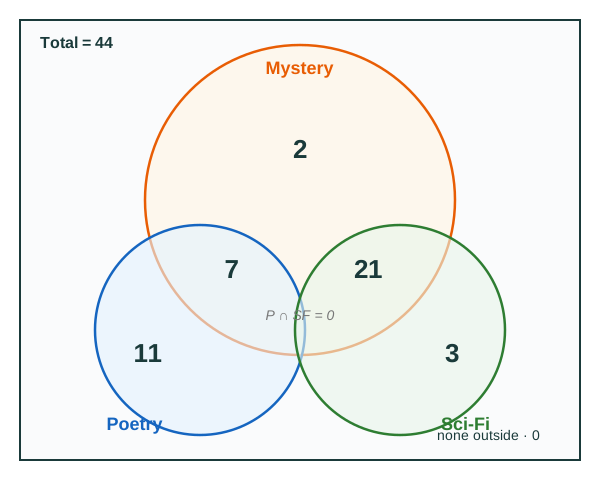
Key moves:
- "7 read poetry and mystery" → with the centre = 0 (see callout below), all 7 sit in P ∩ M only.
- "Three times as many read science fiction and mystery" → 3 × 7 = 21, all in S ∩ M only (centre = 0).
- 11 in only P, 3 in only S.
Hidden inference - the move many candidates miss.
"No member had read both poetry and science fiction" gives you P ∩ S = 0 directly. But the three-way centre P ∩ S ∩ M is part of P ∩ S, so it's zero too. Without this step you can't resolve the pairwise overlaps. Any time the passage rules out a pairwise overlap in a 3-set Venn, the centre will be 0 too.
The trick - ignore the middle. The question asks how many more in M than in P.
Naive approach: work out M only, then sum the whole of M, then sum the whole of P, then subtract. Three additions plus a subtraction.
Shortcut: When you want the difference between two intersecting groups, the shared region cancels. So:
  M − P = (M only + M∩S only)  −  (P only)
       = (M only + 21) − 11
Then we still need M only: M only = 44 − 0 − 11 − 7 − 3 − 21 = 2. So M only + 21 = 23, and 23 − 11 = 12.
Time check
~75 seconds. The shortcut saves a few seconds and reduces the chance of an arithmetic slip - the longer the numbers, the more time the shortcut saves.
Worked example 2: gardening centre - the units-digit trick
A gardening centre surveyed 38 customers about which type of plants they had bought. Each customer had bought at least one type: shrubs, flowers, or herbs.
- 18 customers bought shrubs.
- 2 customers bought flowers and herbs only.
- 10 customers bought shrubs and herbs.
- 7 customers bought only flowers.
- 5 customers bought all three types.
- 4 customers bought only shrubs.
Question: How many customers bought herbs only?
A) 6 B) 8 C) 11 D) 4
Set up. Rectangle = 38. Outside = 0.
Fill inside-out.
- All three (centre) = 5.
- "10 bought shrubs and herbs" - careful, this includes the centre. So S ∩ H only = 10 − 5 = 5.
- "2 bought flowers and herbs only" = 2 (already qualified with "only").
- Only S = 4. Only F = 7.
- S ∩ F only - not given directly. Shrubs total = 18 = (only S) + (S∩F only) + (S∩H only) + (centre) → 18 = 4 + x + 5 + 5 → x = 4.
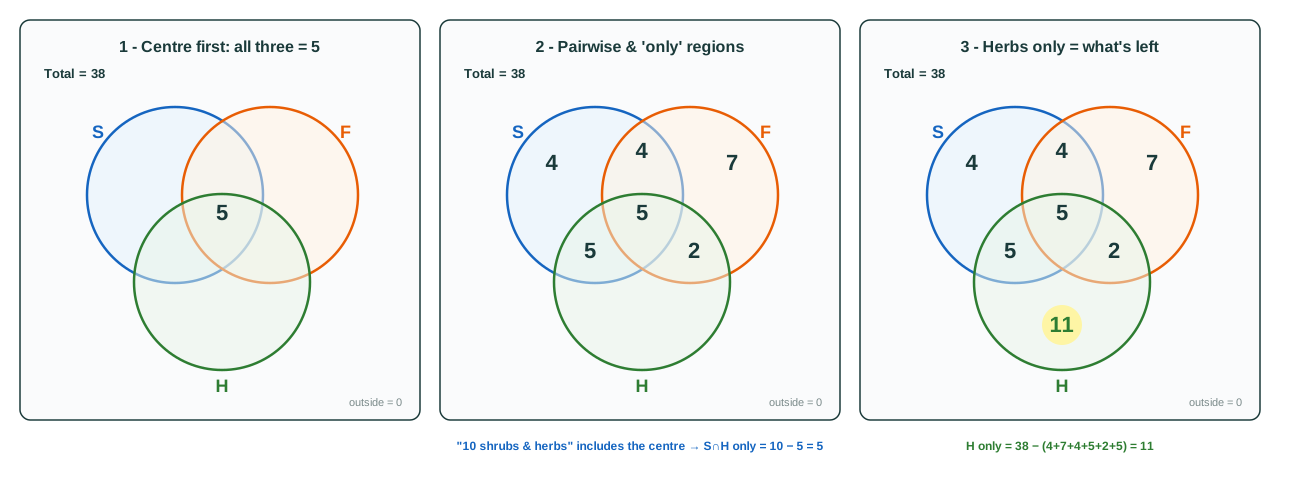
The trick - units-digit subtraction. We want H only. Conventional: 38 − 4 − 4 − 5 − 5 − 2 − 7 = 11. Six subtractions in a row, easy to slip.
If the four answer options end in different units digits (6, 8, 1, 4 here), you only need the units digit of the answer:
  8 (from 38)
  − 4 = 4
  − 4 = 0      (think mod 10: 0 − 4 = 6 → next step uses 6)
  Wait - easier: 8 − 4 − 4 − 5 − 5 − 2 − 7 ≡ ? (mod 10)

  Track just units, allowing borrows:
    8 − 4 = 4
    4 − 4 = 0
    0 − 5 = 5 (borrow)
    5 − 5 = 0
    0 − 2 = 8 (borrow)
    8 − 7 = 1
Units digit = 1. Only option C (11) ends in 1. Answer: C.
Time check
~60 seconds. The units trick saves real time when the numbers get bigger (subtracting 107 − 53 − 11 − ... in your head is error-prone; tracking the units digit is mechanical).
The trick fails when two options share the same units digit. Glance at the options first to confirm.
Worked example 3: diners - the nested-Venn collapse
58 diners at a restaurant each ordered at least one of three courses: a starter, a main, and a dessert.
- 35 ordered a main.
- 28 ordered a dessert.
- 22 ordered a starter.
- Everyone who ordered a starter also ordered a main.
Question: How many ordered dessert only?
The trap: it looks like a 3-set problem. "22 ordered a starter" implies a third circle. Most candidates burn 90 seconds drawing all the intersections.
The trick - collapse. "Everyone who ordered a starter also ordered a main" means starters are a subset of mains. The starter circle sits entirely inside the main circle. You can ignore it.
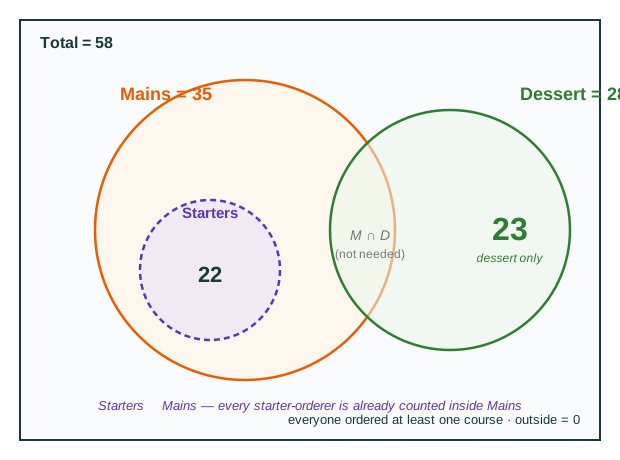
Now it's a 2-set diagram. Dessert only = Total − Mains = 58 − 35 = 23.
Why this works even when starters overlap with dessert: because every starter-orderer is already counted inside Mains, the "everyone ordered at least one course" rule means the only people missing from Mains are those who ordered dessert only. Total − Mains = dessert only. Three seconds of arithmetic.
Time check
~15 seconds with the trick. ~2 minutes without. The "X is a subset of Y" phrasing is the trigger - anytime you see "everyone who [did X] also [did Y]," check whether the diagram simplifies.
Three speed tricks - when to reach for each
| Trick | When to use it | Saves |
|---|---|---|
| Ignore the middle intersection | Question asks for a difference between two intersecting groups | One addition cycle |
| Units-digit subtraction | Options end in distinct digits AND there's a long subtraction chain | 10-30 seconds on a big sum |
| Nested-Venn collapse | One set is a subset of another ("everyone who… also…") | Up to 90 seconds |
The overlap trap (the most common Venn error)
When a question says "15 people do A, 12 people do B, 5 do both," the 5 is already inside both the 15 and the 12. So:
- People who do A or B = 15 + 12 − 5 = 22 (not 27).
- "Only A" = 15 − 5 = 10.
The inside-out fill prevents this - by writing the intersection first and then subtracting from each circle's total, you never double-count.
Same idea in 3-set: "10 bought shrubs and herbs" includes everyone in the centre. So S ∩ H only = 10 − (all three).
Flipping (the negative-to-positive move)
When the question gives you a don't, flip it:
"100 students don't play football. Total = 300."
→ 300 − 100 = 200 students do play football.
Work with the positive value. Negations are error-prone.
Common Mistakes
- 1.Forgetting the rectangle. "Total" and "neither" live outside the circles. Many questions hinge on the "neither" region.
- 2.Reading "A and B" as "A and B only". "10 bought shrubs and herbs" includes people who bought all three. "10 bought shrubs and herbs only" doesn't. The word only changes everything.
- 3.Working outside-in. Always fill the centre first, then pairwise overlaps, then "only" regions. Outside-in cascades errors.
- 4.Spending 2+ minutes on a diagram-matching question. Checking four diagrams region by region against six constraints is slow - if you find yourself over two minutes, make your best choice and move on.
- 5.Missing the subset collapse. "Everyone who did X also did Y" is a strong signal that a 3-set problem reduces to a 2-set problem.
Summary
| Element | Detail |
|---|---|
| Format | MC (4 options, 1 mark) |
| Sub-types | Calculation vs Diagram-matching / qualitative |
| Technique | Rectangle + circles → fill inside-out → use total as check |
| 2-set | 4 regions (only A, A∩B, only B, neither) |
| 3-set | 8 regions; fill centre first |
| Speed tricks | Ignore middle for differences; units-digit subtraction; nested-Venn collapse |
| Time target | 45-60 seconds (calculation) |
| Key trap | "X and Y" includes everyone in the centre; not the same as "X and Y only" |
Put It Into Practice
Apply the strategies learned in this lesson to real UCAT questions.