
Situational Judgement·Lesson 5.1·6 min read
Introduction
What This Section Tests
Situational Judgement is a professional ethics test. You're given workplace scenarios - usually involving medical and dental students, junior doctors, or healthcare teams - and asked to evaluate responses or factors using established ethical principles.
You don't need medical knowledge. You need to think like a medical professional: someone who puts patient safety first, acts with integrity, and handles conflict constructively.
Common sense matters here, but it has to align with medical ethics, not personal opinion. That distinction trips up a lot of students.
The Format
You get ~20-25 scenarios with 2-6 questions each, totalling 69 questions in 26 minutes (plus 1.5 minutes of instructions). That's roughly 23 seconds per question - the fastest pace in the UCAT.
Two question formats appear in the section:
| Format | Options | Marks | Scoring |
|---|---|---|---|
| Multiple choice | 4 options | 3-4 | Partial marks for close answers |
| Drag and drop (Ranking) | Choose 2 statements from 3 | 8 | All-or-nothing |
Band Scoring - Not Like Other Sections
SJT is the only UCAT section that doesn't produce a numerical score on the 300-900 scale. Instead, you get a Band from 1 to 4. (That's the UK version - if you're sitting the UCAT ANZ in Australia or New Zealand, Situational Judgement is reported as a separate scaled score from 300-900, and there are no bands.)
| Band | What It Means |
|---|---|
| Band 1 | An excellent level of performance, showing similar judgement in most cases to the panel of experts. |
| Band 2 | A good, solid level of performance, showing appropriate judgement frequently, with many responses matching model answers. |
| Band 3 | A modest level of performance, with appropriate judgement shown for some questions and substantial differences from ideal responses for others. |
| Band 4 | A low level of performance, with judgement tending to differ substantially from ideal responses in many cases. |
Band descriptors: UCAT Consortium
One thing worth knowing about how the SJT is scored: not every question is worth the same number of marks, and on rating questions an answer close to the correct one still earns partial marks. Consistency beats perfection - a steady stream of near-misses scores far better than nailing some questions and bombing others. There's no negative marking, so never leave a question blank.
Most medical schools consider your SJT band alongside your cognitive score, and at some schools a low band can mean automatic rejection - so treat the SJT as a section worth preparing for, not an afterthought. Check how your target schools use it below.
How medical schools use the SJT
Medical schools vary in how they weight the SJT. Common approaches include:
- Threshold - Some schools require Band 1 or 2 to be considered (e.g., Band 3 or more commonly Band 4 may result in automatic rejection)
- Tie-breaker - Used to differentiate between candidates with similar cognitive scores or at the interview stage
- Weighted into overall score - Combined with your cognitive UCAT score, though usually weighted less heavily. It can be weighted when shortlisting for interview, in selection from interview, or both.
Check each medical school's admissions policy, as SJT usage differs significantly. A few schools do not consider the SJT at all.
The Formula: Recognise, Triage, Apply
Here's every question type you'll face, the technique for each, and when to skip. This is the formula - recognise, triage, apply.
| Question type | Technique | Triage |
|---|---|---|
| Rating Importance (~35-38% of SJT) | The Relevance Filter - matters or doesn't? how much? | Priority 1 (15-20s, partial marks) |
| Rating Appropriateness (~55-60% of SJT) | The 50/50 Split - good or bad? how much? | Priority 1 (15-20s, partial marks) |
| Ranking (Most / Least Appropriate) (~5% of SJT) | Isolation + Verb Analysis - spot the obvious, compare remaining two | Priority 2 (25-30s, all or nothing) |
The section always runs in this order: rating importance questions first, then rating appropriateness, with ranking questions as the final 3-4 questions.
Foundation for all types: the CHEAP PET ethics framework (5.2 The Ethics Framework) - Confidentiality · Honesty · Empathy · Autonomy · Patient safety · Professionalism · Equality · Teamwork.
All SJT question types are fast - there's no "skip" category. If you're behind, prioritise rating questions (partial marks protect you) over ranking questions (all or nothing).
The 3 Question Types
Every SJT question falls into one of three categories. Recognising the type tells you which technique to use and whether partial marks are available.
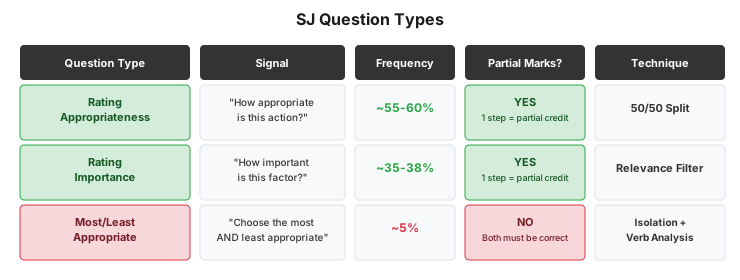
The question types always appear in this fixed order: rating importance first, then rating appropriateness, then ranking as the final 3-4 questions of the section.
How Each Type Works
Rating Importance
You rate a single factor (a consideration) on a 4-point scale:
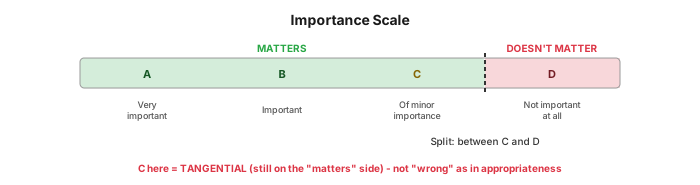
If the answer is A and you pick B or C, you receive a partial mark (smaller for C than for B). Only D scores nothing.
Rating Appropriateness
You rate a single proposed action on a 4-point scale:
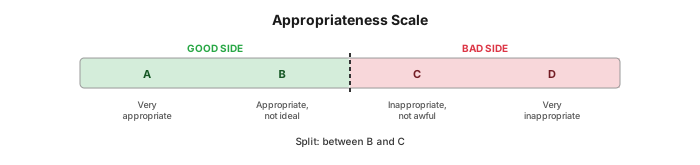
Partial marks work the same way here.
Here's what catches most students: C means something different in each type. In appropriateness, C means the action is wrong. In importance, C means the factor is tangential - it has some peripheral relevance but shouldn't drive the decision. We'll cover this in detail in 5.4 Rating Importance, but flag it now because it's the single most-missed concept in the whole SJT section.
Ranking (Most/Least Appropriate)
You see 3 possible actions. You pick the most appropriate AND the least appropriate. Both must be correct. No partial marks - all or nothing. These are always the last 3-4 questions of the section.
The Ethical Foundation: CHEAP PET
Every SJT answer traces back to a small set of ethical principles. You don't need to memorise medical guidelines - you need to internalise this mnemonic:
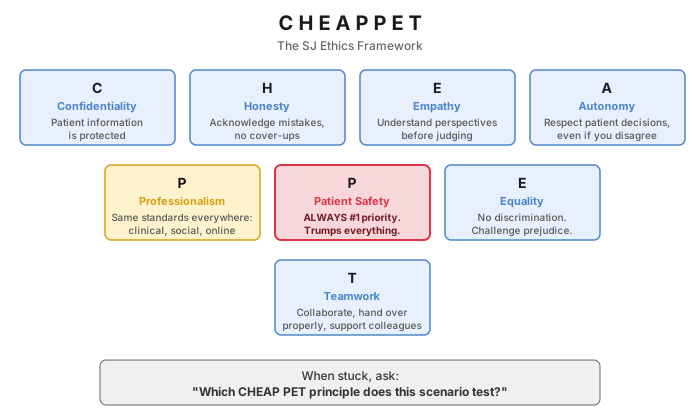
When you're stuck on any SJT question, ask: "Which CHEAP PET principle does this scenario test?" That almost always points you to the right response.
How It All Fits Together
Here's the decision process you'll use for every SJT question:
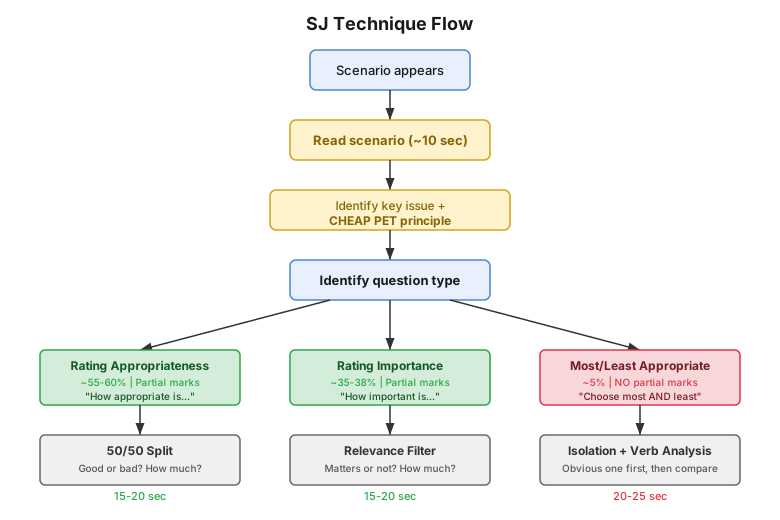
Worked Example: Seeing the System in Action
Let's walk through a complete scenario so you can see how this fits together before we get into the individual techniques.
Scenario: Priya is a third-year medical student on placement. During a ward round, she notices that Dr Okafor, the registrar, prescribed penicillin for a patient whose notes clearly state a penicillin allergy. Dr Okafor is well-liked on the team and has been very supportive of Priya during her placement.
"How appropriate are each of the following responses by Priya..."
Action 1: Immediately inform Dr Okafor about the allergy noted in the patient's records.
Identify the key issue: Patient safety - wrong medication could cause a serious allergic reaction.
CHEAP PET principle: Patient Safety (P)
Is this good or bad? GOOD - she's flagging a danger.
How good? This directly addresses the safety risk.
Answer: A (Very appropriate)
Action 2: Wait until after the ward round to mention it, so as not to embarrass Dr Okafor in front of the team.
Good or bad? BAD - patient safety requires immediate action. Delaying because of social discomfort puts the patient at risk. The patient could receive the medication before the ward round ends.
Answer: D (Very inappropriate)
Action 3: Ask the nurse assigned to the patient whether they are aware of the allergy before administering the medication.
Good or bad? GOOD - she's trying to prevent harm.
How good? It addresses the safety concern, but indirectly. The most direct route is telling Dr Okafor. Going via the nurse adds a step and the nurse might not feel empowered to challenge the registrar's prescription.
Answer: B (Appropriate, but not ideal)
Action 4: Assume Dr Okafor must have a clinical reason for prescribing penicillin despite the recorded allergy.
Good or bad? BAD - assuming is not safe when a patient could have a serious allergic reaction. This is passive. It avoids the issue entirely based on an assumption. If the assumption is wrong, the patient is harmed.
Answer: D (Very inappropriate)
Notice the pattern: friendship and social comfort don't factor in. Patient safety overrides everything. The most direct action that addresses the core risk scores highest.
The Mindset Shift
Most students approach SJT by asking "What would I do?" Wrong question. Many SJT answers feel counterintuitive because they follow professional ethics, not personal instinct.
The SJT mindset:
- You're not answering as yourself - you're answering as an ideal medical professional
- "Explore before judging" - asking "why?" is almost always better than telling someone what to do
- Patient safety overrides everything: friendships, grades, personal convenience, hierarchy
- Local resolution first - don't escalate to seniors when you can resolve it yourself (unless patient safety is at immediate risk)
- Never prioritise self-interest: reputation, grades, fear of consequences are almost always irrelevant
What's Ahead
| Lesson | What It Covers |
|---|---|
| 5.2 Ethics Framework | The four pillars of medical ethics + CHEAP PET applied to real scenarios |
| 5.3 Rating Appropriateness | The 50/50 Split technique for rating actions in under 20 seconds |
| 5.4 Rating Importance | The Relevance Filter - plus why the C option means something different here |
| 5.5 Ranking (Most/Least Appropriate) | Isolation + Verb Analysis for the all-or-nothing questions |
| 5.6 Themes & Technique Map | Recurring scenario patterns + the complete SJT decision system |