
Verbal Reasoning·Lesson 2.1·3 min read
Introduction
What This Section Tests
Verbal Reasoning is not a reading comprehension test. It's a textual comparison test. You're given a passage and a series of statements or questions. Your job is to determine whether the information in the statement matches, contradicts, or falls outside the passage.
You don't need to understand the passage deeply. You don't need to remember it. You need to compare two pieces of text accurately and quickly.
The Format
| Questions | 11 passages × 4 questions = 44 questions |
| Time | 22 minutes (+1.5 min instruction time) |
| Pace | 30 seconds per question / ~2 min per set |
That's 11 different passages (each ~200-400 words of unfamiliar non-fiction), with 4 questions attached to each one. Topics vary widely: science, history, law, economics, culture. You don't need prior knowledge - all answers come from the passage.
The Formula: Recognise, Triage, Apply
Here's every question type you'll face, when to skip it, and the technique for each. This is the formula - recognise, triage, apply.
| Question type | Triage | Technique |
|---|---|---|
| True / False / Can't Tell | Always attempt | Targeted Read (MOO framework) |
| According to the Passage | Always attempt | Keyword-to-Sentence |
| Complete the Statement | Always attempt | Keyword-to-Sentence + Completion Check |
| Author's Opinion | Attempt if on pace | Intro + Conclusion |
| Summarise / Main Theme | Attempt if on pace | First Sentence Scan |
| Best Supported / Inference | Skip if behind | Option Scan |
| Except / Negative | Skip if behind | Inverted Elimination |
| Other Hard Types (Word Ref, New Info, Why) | Skip if behind | Context Read / Read Backwards / Apply Passage's Rules |
The first three types make up ~60-65% of all VR questions and take 10-30 seconds each. Master them first - they're where your marks come from.
The 7 Question Types
Every VR question falls into one of seven categories. Recognising the type instantly tells you which technique to use.
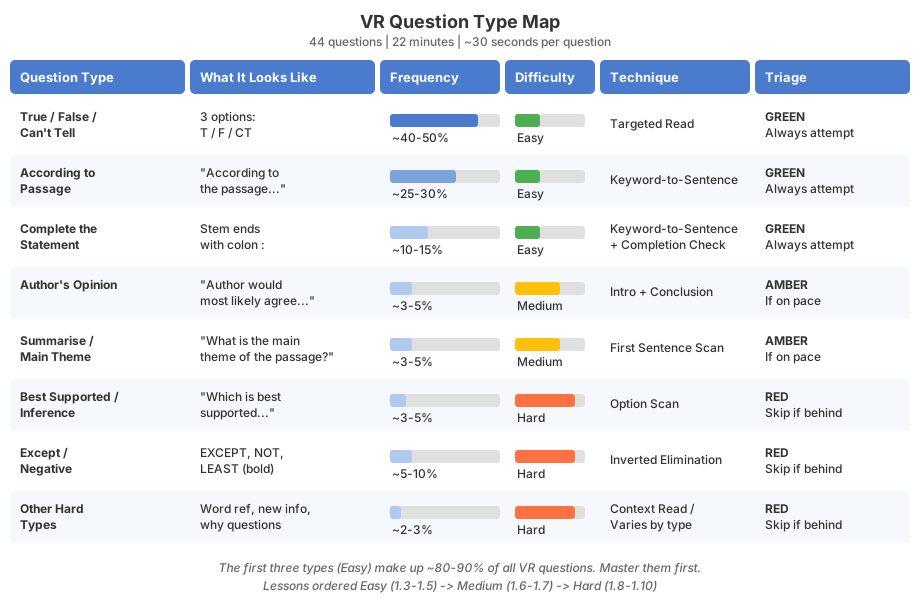
Key insight: The first three types (T/F/CT, According to Passage, Complete the Statement) make up ~60-65% of all VR questions and are the most straightforward. Master them first.
The Core Logic: Match / Opposite / Outside
Every VR answer boils down to one of three relationships between the statement and the passage:
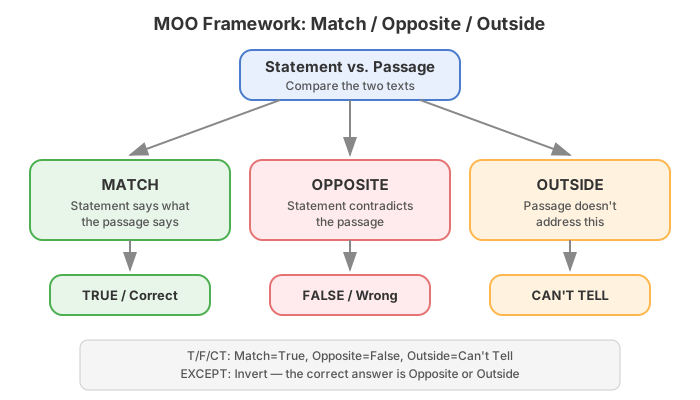
This MOO framework (Match, Opposite, Outside) applies to every VR question type:
- In T/F/CT: Match = True, Opposite = False, Outside = Can't Tell
- In multiple choice: the correct answer is the Match; wrong answers are Opposite or Outside
- In Except questions: you invert the logic (the correct answer is the one that's Opposite or Outside)
The VR Technique Flow
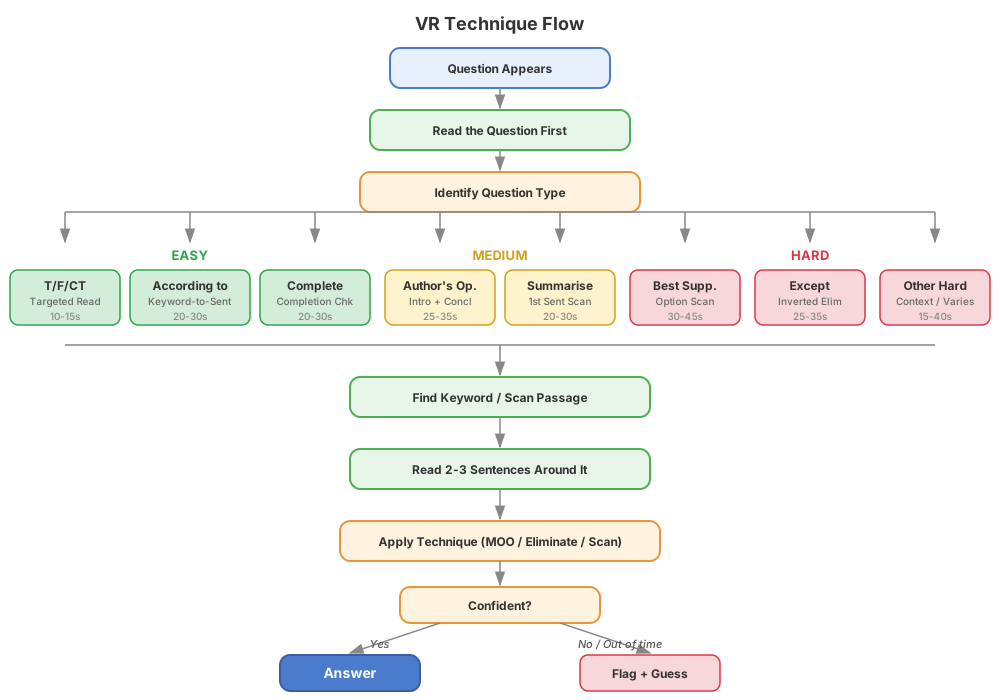
Here's how all the techniques connect - from the moment a question appears to the moment you answer it:
What You'll Learn in This Module
Lessons are ordered from easy to hard. Master the early lessons first - they cover the most common question types and give you the biggest score gains.
| Lesson | Topic | Difficulty | You'll learn to... |
|---|---|---|---|
| 2.2 How to Read | Reading technique | - | Use scanning (not reading) to find information in 5-10 seconds |
| 2.3 Finding Keywords | Keyword selection | - | Pick the right keyword that takes you straight to the answer |
| 2.4 True/False/Can't Tell | T/F/CT | Easy | Apply MOO logic + spot language traps (qualifiers, tense, scope) |
| 2.5 According to Passage | According to Passage | Easy | Use Keyword-to-Sentence technique + handle cause-effect questions |
| 2.6 Complete the Statement | Incomplete Statements | Easy | Recognise colon-ending stems + choose the completion that matches the passage |
| 2.7 Author's Opinion | Author Opinion | Medium | Read intro + conclusion to determine the author's stance |
| 2.8 Summarise | Main Theme / Summing Up | Medium | Use First Sentence Scan to find the passage's dominant theme |
| 2.9 Best Supported | Inference | Hard | Use Option Scan + the Least Wrong Principle for vague question stems |
| 2.10 Except | Except / Negative | Hard | Invert your logic and use systematic elimination |
| 2.11 Other Hard Types | Word Reference, New Info, Why | Hard | Handle rare question formats without losing time |
| 2.12 Triage & Technique Map | Strategy | - | Prioritise questions, manage time, and apply all techniques together |
Before You Start: The Mindset Shift
Most students approach VR like a school English exam - read the passage, understand it, then answer questions. This is the slowest possible approach.
The VR mindset:
- You're a scanner, not a reader
- You go to the question first, not the passage
- You find the one relevant sentence, not the full argument
- You compare wording, not meaning in the abstract
- You move on immediately once you have an answer - don't second-guess
The rest of this module will teach you exactly how to do this.