
Ethics·Lesson 3.3·6 min read
Professionalism
What are professionalism questions?
Most doctors will, at some point, see a colleague behave unprofessionally. A colleague might arrive unfit to work, skip a safety check, or treat a patient or a member of staff disrespectfully. Professionalism stations ask what you'd do when someone's behaviour falls short of the professional standards expected of them. They can feel like dilemmas, because you want to be loyal to the person but you also know what the right thing to do is. Unlike dilemmas, though, they usually have a right answer. Patient safety comes before protecting a friend, and doing nothing is never right when there's a genuine concern. You need to respond in proportion to the risk, which means being firm about the problem while staying fair to the person.
Examples of professionalism questions
The person is often a friend or someone senior to you, which is what makes it hard:
- "A friend on your course tells you they cheated in an exam. What do you do?"
- "A friend asks you to sign them in to a compulsory class because they're too hungover to come. What would you do?"
- "A senior colleague makes belittling remarks about staff on ward rounds. What would you do?"
The SPIES framework
For these questions, we recommend the SPIES framework. Take the steps in order, with one exception: if a patient is at risk right now, patient safety comes first.
- 1.Seek information. Find out what happened before you act. Did you see it yourself? Could there be an innocent explanation? This stops you accusing someone on incomplete evidence, but it mustn't become a reason to wait when patients could be harmed. The GMC is clear that you don't need proof before raising a concern.
- 2.Patient safety. Ask whether anyone is at risk, now or in the future. A friend who cheats in an exam harms nobody today, but a doctor who qualified without the knowledge could. That's why the GMC lists exam cheating, and even signing a friend in to a class they missed, among the concerns that can lead to fitness-to-practise proceedings for medical students. If there's a risk, deal with it first and find out the details afterwards.
- 3.Initiative. Do what you reasonably can yourself, at your level. Usually that's a calm, private conversation: "I noticed..., is everything okay?" It gives them a chance to explain or put it right. Know your limits: a sixth-former on work experience can do much less than a medical student.
- 4.Escalate. If it isn't resolved, keeps happening, or puts anyone at risk, involve someone more senior. Where it's safe, give the person the chance to report it themselves first. If they won't, tell them you're going to, rather than going behind their back, and leave the investigating to whoever you've told.
- 5.Support. Unprofessional behaviour is often a sign that someone is struggling with stress, illness or addiction. Support the patient, the colleague and yourself.
How far to escalate
Most mistakes in these answers are about escalation, and the two most common are opposites. One is doing nothing, usually to protect a friend. The other is going straight to the top: "I'd report them to the GMC." Interviewers are looking for a proportionate response, so start at the lowest step that keeps patients safe, and go further only if you need to.
A useful way to picture this is the escalation ladder:
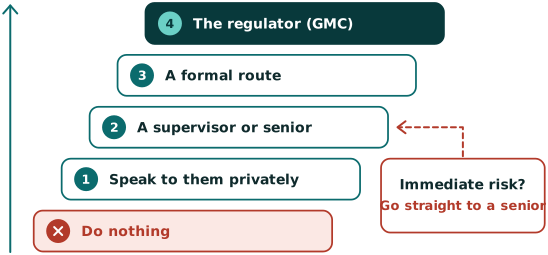
Doing nothing is never right if there's a genuine concern. Above it, each rung is for a more serious or more persistent problem:
- 1.Speak to them privately. Usually the right first step when nobody is at immediate risk. It gives them a chance to explain or put it right.
- 2.A supervisor or senior. If that doesn't resolve it, it keeps happening, or patients could be affected.
- 3.A formal route. If it's serious or seniors don't act. At medical school, that's your personal tutor or year lead. In the NHS in England, it's a Freedom to Speak Up Guardian, whose job is to help staff raise concerns safely. Scotland, Wales and Northern Ireland have their own routes.
- 4.The regulator (GMC). Only for serious concerns about a doctor that haven't been dealt with locally. For a fellow student, the top step is the medical school's fitness-to-practise process.
If a patient is at immediate risk, skip the early steps. For example, if a doctor is about to see patients while under the influence of alcohol, a private conversation is not enough, and you should inform a senior immediately.
A worked example
"You're on work experience, and the doctor you're shadowing smells of alcohol. Clinic starts in ten minutes. What do you do?"
Applicants tend to give one of two answers, and they are the two mistakes described above. "I'd say nothing, I'm only a student" leaves patients at risk. "I'd report them" skips every step in between.
A strong answer:
"First, I'd want to be sure of what I'm seeing. A smell of alcohol could be from the night before, so I'd look for other signs, like slurred speech or unsteadiness. But I'm not in a position to judge whether they're impaired, and I can't let that become a reason to wait, because patients are about to be seen.
The risk to patients is immediate, so this can't wait until after clinic. As a work experience student, my role is limited, and I wouldn't confront them in front of patients. So before clinic starts, I'd quietly tell a senior: my supervisor, another senior doctor or the practice manager. I'd explain what I'd noticed, factually, without accusing them.
I'd also remember that the doctor may be struggling with their health, stress or even addiction, so they may need support as much as discipline. Afterwards, I'd talk it through with someone myself."
This answer is humble about the student's role without using it as an excuse to do nothing. It also goes to a senior straight away, because the risk is immediate. If the same doctor had been rude to a nurse instead, the right first step would be a private word. The framework is the same in both cases, but the step you start on depends on the level of risk.
When the interviewer changes the facts
Follow-up questions in these stations usually change the risk, to see whether your response changes with it. "This is the fourth time this term." "They're about to start a placement." "It was a one-off and they're mortified." Move up or down the ladder and say why.
Other follow-ups test whether you will maintain your position under pressure: "Your friend says everyone does it and you're being a bad friend." Maintain your position while remaining kind. You can refuse to cover for someone and still help them, by sharing notes, going with them to see a tutor, or checking how they're doing.
In role-play stations, the actor may bargain ("If I promise not to do it again, you won't tell anyone, right?") or get upset. Don't accept a deal that leaves the problem unresolved, and don't threaten them with the GMC to win the argument.
When it's your own conduct
Some questions are about your own boundaries rather than someone else's behaviour: a patient offers you a gift or asks for your number, or a friend asks you to prescribe for them. The same thinking applies. Ask whether it could affect your judgement, the patient's trust or their safety, be open about it, and say no kindly where you need to. A small thank-you gift is usually acceptable, but you should decline anything that could be seen as influencing the care you provide.
What's next
The next lesson covers your own mistakes. The steps are similar, but the person whose behaviour is in question is you, and what's being tested is honesty.
Put Your Knowledge to the Test
Tackle ethics questions from real medical school interviews with our realistic AI interviewer, then receive personalised feedback and model answers.