
Decision Making·Lesson 3.2·14 min read
Syllogisms
Recognising This Question Type
Syllogism questions are the first question type in the DM section. They give you a short paragraph - usually no more than three or four sentences - followed by five statements that you drag yes or no.
These make up 6-7 questions of the 35 in DM (it varies slightly between papers). Target time: 45-90 seconds per set.
Marking scheme
Syllogisms (and Interpretation questions, which use the same drag-and-drop format) are the only DM questions worth more than one mark. The marking is unforgiving on accuracy:
| Correct out of 5 | Marks |
|---|---|
| 5/5 | 2 |
| 4/5 | 1 |
| ≤ 3/5 | 0 |
With the rules and techniques below, four or five out of five is realistic for almost every set.
When to say Yes, when to say No
This is the most important rule in DM, and it's where most people lose marks early on:
There is no "Can't Tell." You answer Yes if you're confident the statement follows from the given information. You answer No in two situations:
- 1.The information directly contradicts the statement, OR
- 2.The statement is hypothetically possible to be false based on the wording.
That second case is the one that catches people out. In Verbal Reasoning, "the passage doesn't tell us either way" would be Can't Tell. In DM, it's a No.
So when you're checking a statement, ask: given only what I've been told, could this statement reasonably be false? If yes - even hypothetically - the answer is No.
Two techniques
There are two techniques you can use for syllogisms. You should learn both, but use them for different questions.
- 1.The Arrow Method - the default. Use it for almost every syllogism question. It's faster, scales to chained reasoning, and handles "no" and "some" statements cleanly.
- 2.Venn Diagrams - use only for a small subset of questions where there are lots of overlapping subsets (e.g. lots of "some A are B", "no C are D", "all E are F" relationships between three groups) and spatial information genuinely helps.
The next section bridges from Venn diagrams to the arrow method, because Venn diagrams are familiar from school and they make the underlying logic visible. Once you're comfortable with the bridge, the arrow method will be your default.
Technique A: Venn Diagrams (used sparingly)
What a Venn diagram represents
A Venn diagram turns a syllogism premise into a picture of which combinations of categories actually contain something. Each set is a region, overlaps show shared membership, and the position of a tick or question mark records what the passage has told you so far.
Four conventions matter, and they're the same conventions you'll use on the noteboard:
- Rectangles, not ovals. Hand-drawn ovals get messy under time pressure - overlaps blur and the diagram loses meaning. Rectangles stay crisp.
- Label the perimeter. Write each set's name on the border of its rectangle, never inside, so overlap regions remain readable.
- Tick = something is definitely here. A tick in a region means the passage has confirmed at least one member of that combination.
- Question mark = unknown. A question mark means the passage hasn't told me yet - there might or might not be members in that region. Crucially, a question mark is not the same as empty.
The three quantifier shapes
Each kind of statement produces a characteristic picture. Get comfortable with these before adding rules together.
Statement: "Some fish are ectotherms."
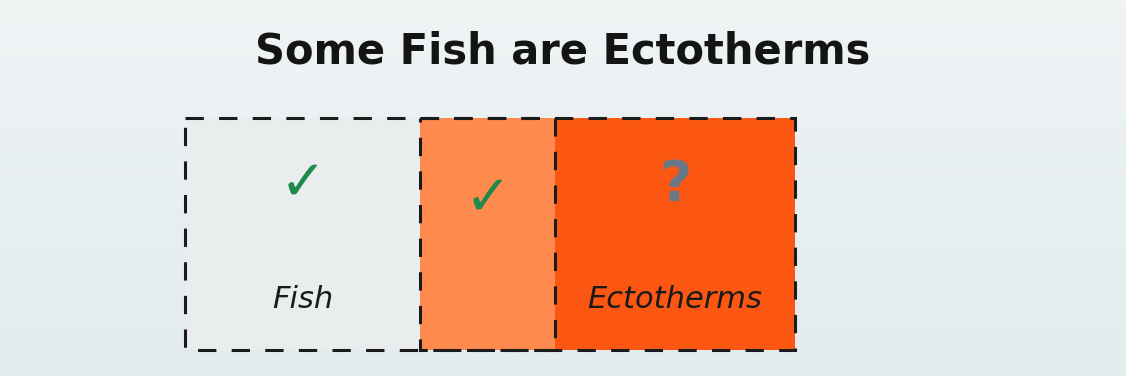
Two rectangles overlap, with a tick in the intersection (at least two fish that are ectotherms). Because UCAT "some" also means not all, at least one fish lies outside the overlap too, so that region gets a tick as well. What stays a question mark is whether any ectotherms lie outside the overlap.
Statement: "No fish are ectotherms."
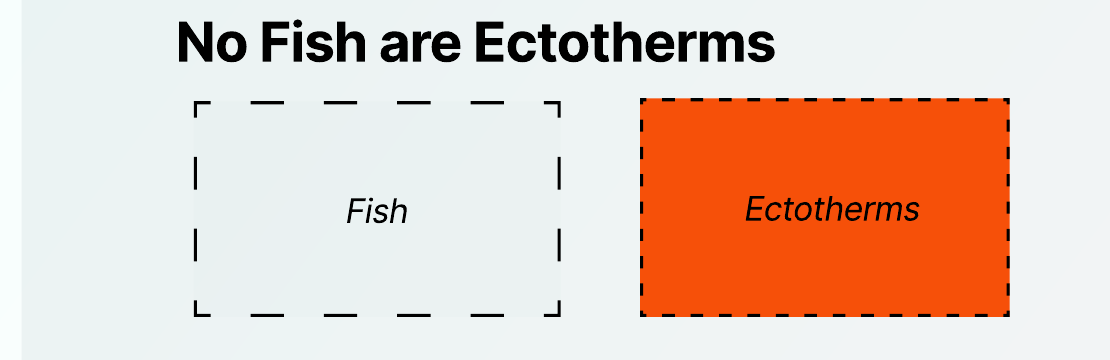
Two rectangles with no overlap. The intersection is empty - strictly zero.
Statement: "All fish are ectotherms."
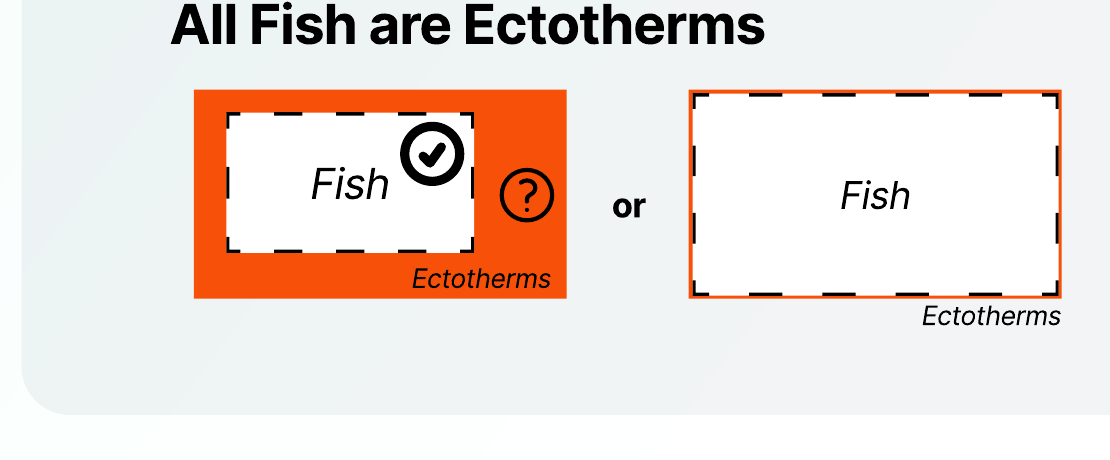
The fish rectangle sits inside the ectotherm rectangle. But - and this is the trap - "all fish are ectotherms" allows two valid pictures: one where the ectotherm rectangle is strictly larger (there are ectotherms that aren't fish), and one where the two rectangles coincide (every ectotherm is also a fish). Because the passage doesn't tell you which, the "ectotherms that aren't fish" region gets a question mark, not a tick.
This last case is where most "All" statements trip people up. Try these questions, assuming only that "all fish are ectotherms" is true:
| Statement | Answer | Why |
|---|---|---|
| At least one ectotherm is a fish. | Yes | The diagram guarantees the fish region sits inside ectotherms. |
| At least one ectotherm must not be a fish. | No | We don't know. The region is a question mark - could be empty. |
| Some ectotherms might not be fish. | Yes | "Might" is uncertain - and our diagram allows for that possibility. |
| No fish are not ectotherms. | Yes | This is the contraposition of the original statement. More on this below. |
Now use the diagram: Frebbles, gants, and horps
The technique recipe is: build in passage order, label the perimeter, tick what's confirmed and question-mark what isn't, then test each statement against the picture. Here's how that plays out on a four-premise passage.
Frebbles, gants and horps are a type of mineral. Most frebbles are gants, and all gants are horps. Some horps that are not gants are frebbles, but a few horps are neither frebbles nor gants.
Build the diagram in passage order:
- 1."Frebbles, gants and horps are a type of mineral." - draw the outer rectangle, label it "minerals."
- 2."Most frebbles are gants." - frebbles and gants overlap. Most of the frebble region sits inside the gant region. Mark a question mark on the "gants only" area (we don't know yet if there are gants that aren't frebbles).
- 3."All gants are horps." - wrap a horp rectangle around the gants region.
- 4."Some horps that are not gants are frebbles." - this confirms there are frebbles outside the gant region but inside the horp region. Tick that area.
- 5."A few horps are neither frebbles nor gants." - tick the area inside horps but outside both frebbles and gants.
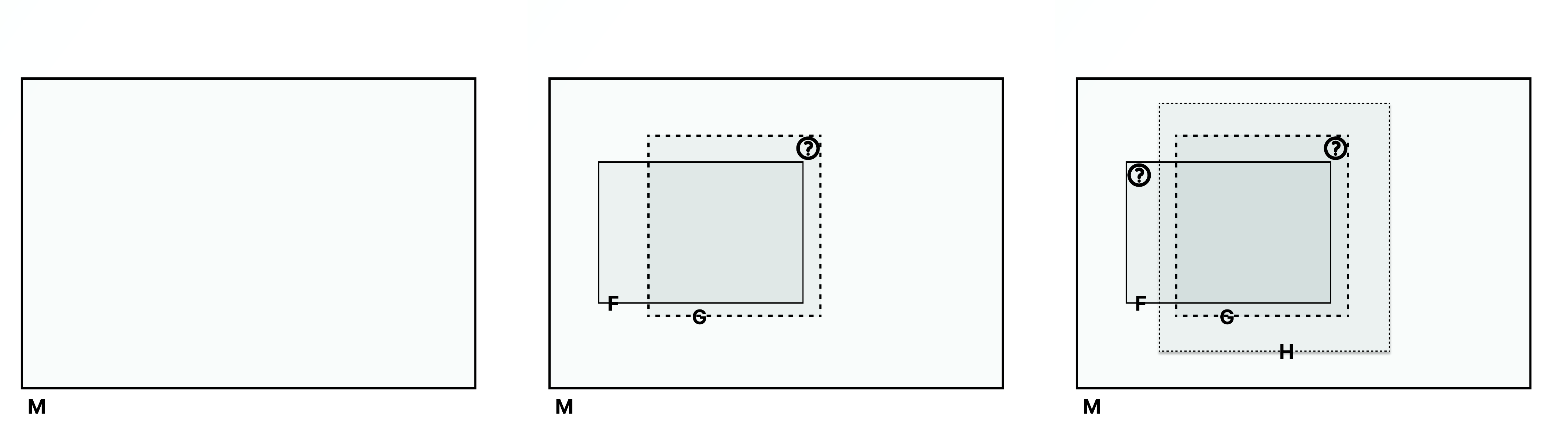
What's still unknown: whether there are any frebbles outside the horp region.
Now the five statements:
| Statement | Answer | Why |
|---|---|---|
| All frebbles are horps. | No | We never confirmed it. There could be frebbles outside the horp rectangle. |
| Some frebbles are not gants. | Yes | We ticked frebbles inside horps but outside gants in step 4. |
| A horp that is not a gant could be a frebble. | Yes | Same region - ticked. |
| There are more horps than gants. | Yes | Step 5 confirmed horps exist that aren't gants. Combined with "all gants are horps," this forces horps > gants. |
| No frebble is both a gant and a horp. | No | Most frebbles are gants (step 2), and all gants are horps - so there are frebbles that are both. |
Technique B: The Arrow Method (your default)
The arrow method takes the same logical content as a Venn diagram and writes it as a chain of arrows. It's faster, scales to longer chains, and handles tricky combinations of all/some/no. The way in is to learn the notation and the four rules first - the technique itself is just apply the rules in passage order.
Arrow notation
| Statement type | Notation |
|---|---|
| All A are B | A ──→ B |
| Some A are B | A ──some──→ B |
| No A are B | A ──X──→ B |
Rule 1: Flipping
You can fully flip some and no arrows. You cannot flip all arrows.
| Original statement | Flipped | Valid? |
|---|---|---|
| Some fish are ectotherms. | Some ectotherms are fish. | ✓ |
| No fish are ectotherms. | No ectotherms are fish. | ✓ |
| All fish are ectotherms. | All ectotherms are fish. | ✗ - the #1 trap |
The all-flip is the most common wrong answer in syllogisms. If a statement reverses the subject and predicate of an "all" premise, it's almost always a No.
Rule 2: Contraposition
You can't flip an all arrow directly - but you can flip it if you also negate both sides.
All fish are ectotherms. → No non-ectotherms are fish.The mechanical move: take "all A are B", swap the sides, and put a "non-" prefix and a "no" on the front.
This is what justifies the row "No fish are not ectotherms" from the fish/ectotherm table earlier - it's the contraposition of "all fish are ectotherms."
Advanced sidebar - other classical rules.
Beyond contraposition, traditional logic also names conversion (swap subject and predicate, no negation - only valid for some and no), obversion (swap polarity and negate the predicate - always valid), and inversion (negate both, no swap - only sometimes valid). In practice the UCAT only ever exploits flipping (= conversion for some/no) and contraposition. If you've heard the other names elsewhere, you don't need to memorise them.
Rule 3: The chain rule
When two arrows share a middle term, you can chain them.
all × all = all: All A → B and all B → C means all A → C.some × all = some: Some A → B and all B → C means some A → C. (The "some" must be on the first arrow; "All A → B and some B → C" does not give "some A → C".)all × no = no: All A → B and no B → C means no A → C.
Think of it as multiplication: alls are like multiplying by 1 (they propagate whatever they meet), and nos are like multiplying by 0 (they turn everything they meet into "no").
Rule 4: Closed-world
Don't assume the question mentions all possibilities. Unless the passage uses the word "only" ("only mammals on this island are dogs and humans"), there could be other entities the passage didn't list.
This is the trap on the "if a creature has a tail but isn't a Tarv, it's a Glink" type of statement in the next worked example. The passage said both Tarvs and Glinks have tails - but never said they're the only tailed creatures.
Putting it together: the technique
With the notation and four rules in hand, the technique is short:
- 1.Write arrows in passage order. As you read each premise, draw the corresponding arrow. Annotate with "most", counts, or other quantifiers when present.
- 2.Rewrite each answer statement as an arrow. Don't try to evaluate it in prose - convert it to the notation first.
- 3.Try to recreate the statement-arrow from your diagram. Use flipping, contraposition, and the chain rule. Stay alert to closed-world: only treat the passage as exhaustive if the word "only" appears.
- 4.Verdict. If you can derive it, Yes. If it contradicts what you can derive, No. If it could go either way, No - there is no Can't Tell.
Worked example: Brezzles, Tarvs, and Glinks
Brezzles, Tarvs, and Glinks are a type of creature found on the island. All Brezzles are Tarvs. No Tarv is a Glink. Both Tarvs and Glinks have tails.
Write arrows in passage order:
Brezzles → TarvsTarvs ──X── Glinks(no Tarv is a Glink)Tarvs → tailsGlinks → tails
Now work each statement as an arrow:
(1) If a creature is a Brezzle, it has a tail. Statement as arrow: Brezzles → tails. Chain it: Brezzles → Tarvs → tails. Recreated. Yes.
(2) No Glink is a Brezzle. Statement as arrow: Glinks ──X── Brezzles. From the diagram: Brezzles → Tarvs ──X── Glinks, which by the chain rule gives Brezzles ──X── Glinks. We can fully flip a no arrow → Glinks ──X── Brezzles. Recreated. Yes.
(3) If a creature is a Tarv, it is not a Brezzle. Statement as arrow: Tarvs ──X── Brezzles. From the diagram we only have Brezzles → Tarvs. Can we flip an all arrow? No. The only valid manipulation is contraposition: non-Tarvs ──X── Brezzles ("no non-Tarvs are Brezzles"). That's a different statement. No.
(4) No Brezzle has a tail. Statement as arrow: Brezzles ──X── tails. Diagram gives Brezzles → Tarvs → tails, i.e. all Brezzles do have tails. Direct contradiction. No.
(5) If a creature has a tail but is not a Tarv, it is a Glink. Statement as arrow: (tails AND non-Tarvs) → Glinks. The passage tells us Tarvs and Glinks both have tails - but never says they're the only tailed creatures. Hypothetically there could be another tailed creature on the island. Closed-world rule applies. No.
*If the passage had said "Only Tarvs and Glinks have tails,"* statement (5) would be a Yes - because then a tailed non-Tarv must be a Glink. Watch for the word "only."
UCAT Quantifier Cheat Sheet
Keep these in working memory throughout the section:
| Quantifier | UCAT meaning |
|---|---|
| All / Every | 100% |
| None / No | 0% |
| Some | more than one, but not all (≥ 2 and < 100%) |
| At least one | ≥ 1 - this is not "some" |
| Most / Majority | > 50% but not all (51-99%) |
| Few | < 50% but more than one (≥ 2 and < 50%) |
| Not all | 1-99% - at least one is, and at least one is not |
Key implications:
- "Some" excludes "all" - and excludes a lone instance. "Some A are B" means at least two A are B and at least one A is not B. "At least one" (≥ 1) is not "some".
- Most → Some (always true)
- Some ⇏ Most (not necessarily)
- Few → Some (always true)
- Not all = 1-99% - rules out both "none" and "all": at least one is, and at least one is not
A → B(all) does NOT giveB → A
Common Mistakes
- 1.Flipping an "all" arrow. "All A are B" doesn't mean "All B are A." This is the #1 source of wrong answers in syllogisms.
- 2.Assuming the closed world. If the question doesn't say "only," don't rule out unmentioned possibilities.
- 3.Treating "some" as "most." "Some fish are ectotherms" is true even if just two fish are ectotherms. Don't read more into it.
- 4.Reading "Can't Tell" into the answer. There is no Can't Tell. Hypothetically possible to be false = No.
- 5.Working without a diagram. Even quick syllogisms benefit from sketching arrows on the noteboard. Don't try to do it all in your head.
Summary
| Element | Detail |
|---|---|
| Format | Short passage + 5 yes/no statements, drag-and-drop |
| Marking | 5/5 = 2 marks; 4/5 = 1 mark; ≤3/5 = 0 marks |
| Default technique | Arrow method |
| Secondary technique | Venn diagrams (for heavily nested set questions) |
| Time target | 45-90 seconds per set |
| #1 trap | Reversal - all A → B does NOT give all B → A |
| #2 trap | Closed-world assumption - only safe if the passage says "only" |
| Yes / No rule | Yes if must follow. No if contradicted OR hypothetically possible to be false. |
Put It Into Practice
Apply the strategies learned in this lesson to real UCAT questions.