
Situational Judgement·Lesson 5.3·8 min read
Rating Appropriateness
Recognising This Question Type
The scenario ends with: "How appropriate are each of the following responses..."
You rate a single proposed action on a 4-point scale:
| A | B | C | D |
|---|---|---|---|
| A very appropriate thing to do | Appropriate, but not ideal | Inappropriate, but not awful | A very inappropriate thing to do |
The left side (A-B) is the good side. The right side (C-D) is the bad side. The split point sits between B and C.
These make up ~55-60% of all SJT questions - more than half the section. Partial marks are available for all rating appropriateness questions. If A or D is the correct answer, then you would get partial marks for options B or C. If B is the correct answer, you would get partial marks for A or C. If C is the correct answer, you would get partial marks for B or D.
Rate each response on its own merits, in isolation - you're not comparing the responses against each other, and several responses in the same set can earn the same rating.
The Technique: The 50/50 Split
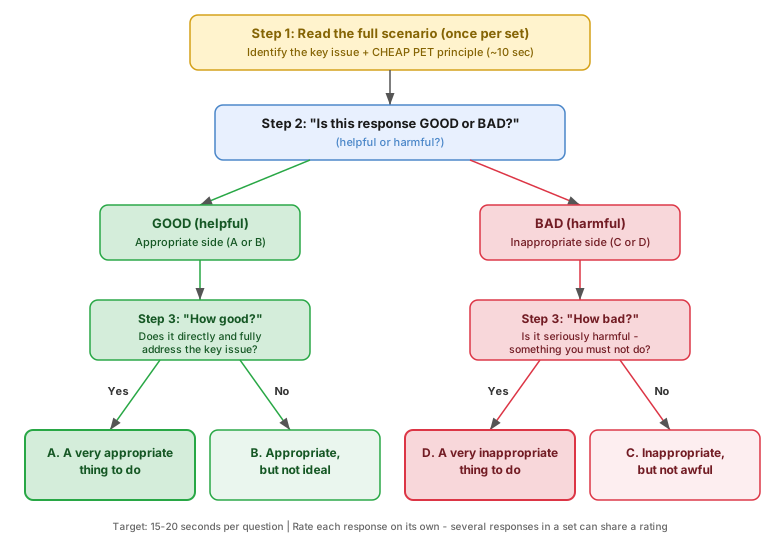
The fastest reliable method for rating appropriateness. It works by halving your options twice - two decisions instead of weighing all four simultaneously.
Step 1: Read the full scenario (~10 seconds). Identify the key issue. What ethical principle is being tested? Use CHEAP PET to anchor yourself. You only need to do this once per set - the scenario stays the same for every question that follows, so don't re-read it each time (only glance back to clarify a detail).
Step 2: First split - Is this response GOOD or BAD?
- Good = A or B (eliminates C and D instantly)
- Bad = C or D (eliminates A and B instantly)
Step 3: Second split - How much?
- If GOOD: A = ideal, directly addresses the key issue. B = acceptable but misses something or is indirect.
- If BAD: C = wrong but causes minimal harm. D = seriously harmful, must not do this.
Target time: 15-20 seconds per question.
Why This Works
The hardest part of SJT isn't knowing the ethics - it's deciding between adjacent options (A vs B, or C vs D). The 50/50 split forces you to make the easy decision first (good or bad?) and then make the harder distinction with only two options, not four.
The B vs C Gray Zone
This is the single hardest distinction in the entire SJT section.
B (Appropriate, but not ideal): The action doesn't perfectly address the problem, but it doesn't make things worse. It partially helps, or it's just not the best approach. There's nothing harmful about it - it's just incomplete or indirect.
C (Inappropriate, but not awful): The action has a negative element. It ignores something important, delays necessary action, is mildly unprofessional, or risks making the situation worse. It's not catastrophic, but there's a clear downside.
The rule of thumb: Ask yourself - "Does this action risk making things worse?" If yes, it's C. If it's just not the best option but doesn't cause harm, it's B.
| Does the action... | B or C? |
|---|---|
| Help a bit, but not address the root cause? | B - it's doing some good |
| Partially address the issue but miss a step? | B - imperfect but not harmful |
| Delay action that should happen now? | C - delay = risk |
| Skip an important step (e.g., not checking with the patient)? | C - the gap could cause problems |
| Involve going to a senior when local resolution was possible? | C - premature escalation for non-safety issues |
| Address the issue but in a slightly blunt way? | B - tone is less ideal, but the action itself helps |
Worked Example: The B/C Boundary
Scenario: Amara is a dental student. During a clinical session, she notices her partner Liam hasn't been washing his hands between patients.
Action: Tell the clinic supervisor that Liam is not following hand hygiene protocols.
Step 1: KEY ISSUE - Infection control / patient safety. Principle: Patient Safety (P).
Step 2: Good or bad? Addressing a hand hygiene breach is GOOD. So it's A or B.
Step 3: The action addresses the problem - Liam's behaviour will be corrected. But it skips local resolution. Amara hasn't spoken to Liam first. For most interpersonal issues, this would make it C (premature escalation).
BUT - hand hygiene is a patient safety issue. It's not just interpersonal. Patients are actively at risk. Going to the supervisor IS appropriate here because safety is involved. But ideally, Amara would also speak to Liam directly.
Verdict: B (Appropriate, but not ideal). Speaking to Liam first AND informing the supervisor = A. Going straight to the supervisor alone = B.
If this were a non-safety issue (say, Liam being rude to Amara), going straight to the supervisor without speaking to Liam would be C. The safety element is what pushes it from C to B.
The Verb Rule
The verb in the proposed action often determines the rating more than the content itself.
Verbs that upgrade toward A: explore, discuss, encourage, suggest, offer, ask. These are collaborative - they respect autonomy and invite dialogue.
Verbs that downgrade toward C/D: tell, demand, threaten, ignore, blame, refuse, dismiss. These are directive, aggressive, or passive.
"Tell" is the most common trap. It frequently downgrades what would otherwise be an A to a B.
Same content, different verb:
- "Encourage Rachel to attend her appointments" - A
- "Tell Rachel about her appointments" - B
- "Explore why the patient is reluctant" - A
- "Tell the patient why the procedure is needed" - B
The content is identical. The verb changes the rating. "Explore/encourage" = collaborative, respects autonomy. "Tell" = directive, paternalistic.
The Boldness Trap
Many students default to B and C - the "safe middle." This is a mistake. SJT questions have more A and D answers than students expect.
The exam uses the full range. Students cluster in the middle, but the actual distribution spreads evenly across all four options. If the action directly addresses the key issue using a collaborative verb, commit to A. If it involves ignoring a problem, covering up, or acting beyond competence, commit to D. Don't hedge.
Context Sensitivity
The same action can be rated differently depending on the scenario. This isn't inconsistency - it's context.
Action: "Speak to a senior about the issue"
- Context 1: Colleague not contributing to group project. Rating: C. Should resolve locally first. Escalating is premature.
- Context 2: Senior doctor prescribed medication patient is allergic to. Rating: A. Patient safety at immediate risk. Must escalate.
Same action. Different context. Different answer. Always check: is patient safety at immediate risk? If yes, escalation is A. If no, local resolution comes first.
Full Worked Example
Scenario: Naomi is a first-year medical student. During a group project meeting, her teammate Dev presents work that Naomi recognises as copied almost word-for-word from an online source. Dev hasn't credited the source. The group's assignment is due in three days.
"How appropriate are each of the following responses by Naomi..."
Action 1: Speak to Dev privately after the meeting about what she noticed.
Key issue: Academic dishonesty / plagiarism. Principles: Honesty (H), Professionalism (P).
Good or bad? GOOD - addressing it directly. A or B?
Directly addresses the issue. Private = respectful, maintains dignity. Local resolution first (no patient safety risk). Verb: "speak" - direct but not aggressive.
Verdict: A (Very appropriate)
Action 2: Ignore it because it's Dev's responsibility, not hers.
Good or bad? BAD - ignoring academic dishonesty. C or D?
Plagiarism undermines the profession. Naomi is complicit if she stays silent and submits the group work containing plagiarised material. Her name will be on the submission.
Verdict: D (Very inappropriate)
Action 3: Email the course tutor to report Dev's plagiarism.
Good or bad? GOOD (plagiarism should be addressed). But has Naomi spoken to Dev first?
She's skipping local resolution. No patient safety issue, so there's no reason to bypass speaking to Dev directly. Reporting without talking to him first is premature.
Verdict: B (Appropriate, but not ideal). If Dev refused to fix it after being approached, then reporting = A.
Action 4: Rewrite Dev's section herself so the group doesn't get in trouble.
Good or bad? BAD. Covering up the plagiarism rather than addressing it. Dishonest because Dev isn't held accountable. Sets a precedent that others will fix his misconduct.
C or D? It removes the plagiarism from the submission (some harm prevented) but doesn't address the underlying dishonesty. It's enabling the behaviour.
Verdict: C (Inappropriate, but not awful). It's not as bad as ignoring it entirely - at least the submitted work won't contain plagiarism. But it avoids the real issue.
Common Mistakes
| Mistake | How to Avoid |
|---|---|
| Defaulting to B or C on everything | Commit to A or D when the action is clearly ideal or clearly harmful |
| Ignoring the verb | Read the verb first. "Explore" and "tell" change the rating even when the content is identical |
| Applying personal values | Ask "What would a medical professional do?" not "What would I do?" |
| Forgetting context | The same action can be A in one scenario and C in another. Check whether patient safety is at risk |
| Overthinking | The 50/50 split takes two decisions, not four. Good or bad? Then how much? Move on |
| Confusing B and C | Ask: "Does this risk making things worse?" Yes = C. No, just not ideal = B |
Summary
| Element | Detail |
|---|---|
| Signal | "How appropriate is this action/response?" |
| Technique | 50/50 Split: Good or Bad? Then how much? |
| B vs C rule | B = not ideal but no harm. C = has a negative element, risks making things worse. |
| Verb rule | Explore/discuss/encourage = upgrade. Tell/demand/ignore = downgrade. |
| Boldness | More answers are A and D than you expect. Don't play safe with B/C. |
| Context | Same action, different scenario = different answer. Check for patient safety risk. |
| Time target | 15-20 seconds |
| Partial marks | Yes - available on every rating appropriateness question. |
Put It Into Practice
Apply the strategies learned in this lesson to real UCAT questions.