
Situational Judgement·Lesson 5.4·8 min read
Rating Importance
Recognising This Question Type
The scenario ends with: "How important to take into account are the following considerations..."
You rate a single factor (not an action) on a 4-point scale:
| A | B | C | D |
|---|---|---|---|
| Very important | Important | Of minor importance | Not important at all |
These make up ~35-38% of all SJT questions. Partial marks are available for all rating importance questions. If A or D is the correct answer, you would get partial marks for options B or C. If B is the correct answer, you would get partial marks for A or C. If C is the correct answer, you would get partial marks for B or D.
Rate each consideration on its own, in isolation - several considerations in the same set can earn the same rating.
The Critical Difference: C Means Something Different Here
This is the #1 most-missed concept in SJT. Students who understand this distinction gain an immediate advantage.
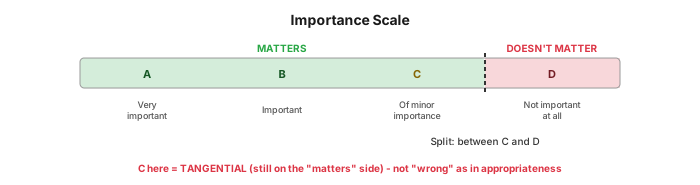
In appropriateness, C means the action is wrong - it causes some harm or is unprofessional. In importance, C means the factor is tangential - it has some peripheral relevance but shouldn't drive the decision. It's not harmful to consider it; it's just not essential.
The split point sits in a different place. For appropriateness, the split is between B and C (good vs bad). For importance, the split is between C and D (some relevance vs none at all). This means C in importance is on the "matters" side of the scale - barely, but it's there.
The Technique: The Relevance Filter
Same 50/50 structure as appropriateness, but with the adjusted split point.
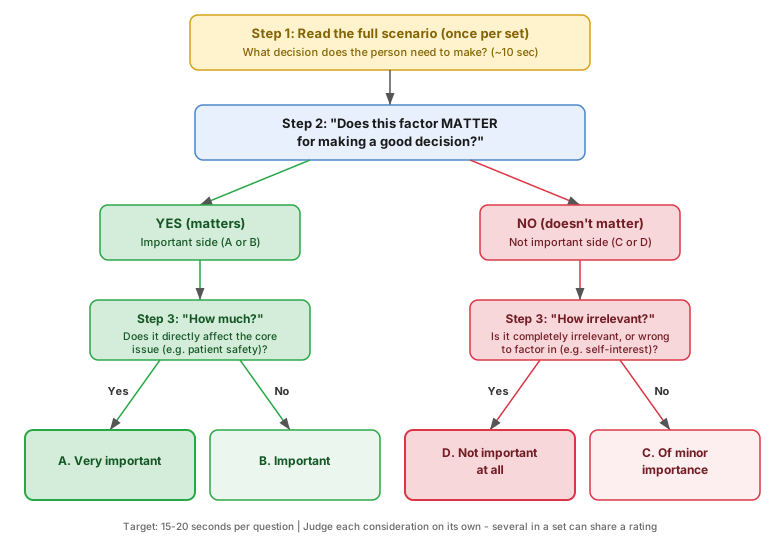
Step 1: Read the full scenario (~10 seconds). Identify the key issue. What decision does the person need to make? You only need to do this once per set - the scenario stays the same for every question that follows, so don't re-read it each time (only glance back to clarify a detail).
Step 2: First split - Does this factor MATTER for making a good decision?
- Yes = A or B
- No = C or D
Step 3: Second split:
- If YES (matters): A = essential, directly affects patient safety, wellbeing, or the core ethical issue. B = important but secondary, affects the situation but isn't the primary concern.
- If NO (doesn't matter): C = minor relevance, has some peripheral connection but shouldn't influence the decision. D = not important at all, irrelevant, or actively wrong to factor in (self-interest, reputation).
Target time: 15-20 seconds per question.
"Very Important" vs "Important" - The A/B Distinction
A = directly related to the core issue. B = relevant but not the central concern.
A (Very important): The factor is directly connected to patient safety, wellbeing, or the primary ethical principle at stake. Removing it would fundamentally change what the right decision is. Examples: patient's allergy status when prescribing, whether the student has been trained to do the procedure, the patient's emotional state if it affects care.
B (Important): The factor matters and should be considered, but it's secondary to the core issue. Removing it wouldn't change the fundamental decision, though it might change how you carry it out. Examples: whether cover is available if someone steps out, the workload of the team, whether similar incidents have happened before.
Think of it this way: A-factors determine WHAT you should do. B-factors influence HOW or WHEN you do it.
Predictable D Answers
These factors appear repeatedly and are almost always D:
| Factor | Why It's D |
|---|---|
| "Her reputation among colleagues" | Self-interest |
| "His assessment grade" | Self-interest |
| "Protecting the friendship" | Self-interest |
| "Fear of consequences for himself" | Self-interest |
| "That other students do it too" | Peer behaviour isn't a justification |
| "It happened a long time ago" | Time doesn't make misconduct acceptable |
| "Wanting to appear competent" | Self-interest |
| "Someone else might report it" | Your duty is independent of what others might do |
When you see any of these, select D with confidence and move on. Don't overthink - these are free marks.
Predictable A Answers
These factors are almost always A:
| Factor | Why It's A |
|---|---|
| "The patient's safety/wellbeing" | Always #1 priority |
| "Her emotional state" (if it could affect patient care) | Affects patient care |
| "Whether the patient has given consent" | Informed consent is fundamental |
| "The university's policy on..." | Policies exist to protect people |
| "Whether the student has been trained to do this" | Competence = safety |
The Tricky Middle: Distinguishing B from C
The hardest distinction is between B (important) and C (minor importance). Use this test:
The "Remove It" Test: If you removed this factor entirely from the decision, would the outcome likely change?
- YES - it's B (Important). It genuinely affects the decision.
- NO - it's C (Minor importance). It's background context, not a driver.
Worked Example: The Relevance Filter in Action
Scenario: Ravi is a second-year medical student. During a hospital placement, a senior nurse asks him to take a blood sample from a patient. Ravi has practised venepuncture on mannequins in skills lab but has never performed it on a real patient. No supervising doctor is currently available on the ward.
"How important to take into account are the following considerations when deciding what Ravi should do..."
Factor 1: Whether Ravi has been trained and assessed as competent to perform venepuncture on patients.
Does this factor matter? YES - this is directly about whether he can safely perform the procedure. Without confirmed competence, he could harm the patient.
A or B? This is the core issue. Remove it and the entire decision changes.
Verdict: A (Very important)
Factor 2: That a supervising doctor is not currently available on the ward.
Does this factor matter? YES - students should perform procedures under supervision. Without a supervisor, he's acting beyond his authority.
A or B? It matters, but it's secondary to the competence question. Even with a supervisor present, if Ravi isn't trained, he shouldn't do it. And even without a supervisor, if he were fully competent, it might be acceptable. But it clearly affects the situation.
Verdict: B (Important)
Factor 3: That refusing might make a poor impression on the senior nurse.
Does this factor matter? No. This is self-interest - worrying about how he's perceived rather than about patient safety.
C or D? This is a classic self-interest factor. Reputation and impression management shouldn't influence a clinical decision.
Verdict: D (Not important at all)
Factor 4: That the patient's blood sample may be needed urgently for their care.
Does this factor matter? Somewhat. The urgency of the sample creates a reason to act, but it doesn't override the safety concern of an untrained student performing the procedure.
B or C? Apply the "remove it" test: if the blood wasn't urgent, would the decision change? Not really - Ravi still shouldn't do it if he's not trained. But the urgency adds relevant context about why finding an alternative quickly matters.
Verdict: C (Of minor importance). It's tangentially relevant - it explains the pressure - but it doesn't change what Ravi should do.
Notice the gradient: A ties directly to the core safety question. B affects the practical circumstances. C is tangential context. D is self-interest. Each step further from the core issue drops one level.
Full Worked Example
Scenario: Fiona is a third-year medical student. Thirty minutes before she's scheduled to assist with a minor surgical procedure, she receives a phone call telling her that her mother has been taken to hospital after a fall. Fiona is visibly upset but says she wants to continue with the procedure.
"How important to take into account are the following considerations when deciding what Fiona should do..."
Factor 1: Fiona's current emotional state.
Does this factor matter? YES - her emotional state could directly compromise patient care. A distressed person assisting in surgery is a safety concern.
A or B? Directly tied to the core issue (safe patient care). Remove it and the entire decision changes.
Verdict: A (Very important)
Factor 2: Whether there's another student or staff member who could assist with the procedure instead.
Does this factor matter? YES - if there's no one else available, the calculus shifts. If cover is available, Fiona stepping out is straightforward. If not, there may be a harder trade-off.
A or B? It matters, but it's secondary. Even without cover, if Fiona is too distressed to assist safely, she shouldn't be there. The primary concern is still her emotional state, not staffing.
Verdict: B (Important)
Factor 3: That this procedure is a valuable learning opportunity for Fiona.
Does this factor matter? Not really. Learning opportunities are nice, but they don't factor into a decision about whether someone is fit to assist in surgery.
C or D? Apply the "remove it" test: if this factor didn't exist, would the decision change? No. But it's not a self-interest factor in the same way as grades or reputation. It has some tangential connection to Fiona's training.
Verdict: C (Of minor importance)
Factor 4: The impact on Fiona's end-of-year assessment if she misses this procedure.
Does this factor matter? No. Assessment grades are self-interest. Patient safety comes before academic performance. Always.
C or D? Classic self-interest factor. It shouldn't influence the decision at all. If Fiona assists while too distressed because she's worried about her grade, that's the wrong reason.
Verdict: D (Not important at all)
Common Mistakes
| Mistake | How to Avoid |
|---|---|
| Treating C in importance like C in appropriateness | Remember: Importance C = tangential (neutral). Appropriateness C = wrong (negative). |
| Rating self-interest factors as C instead of D | If the factor is about grades, reputation, friendship, or fear of consequences, it's almost always D. |
| Overthinking B vs C | Use the "remove it" test. Would removing this factor change the outcome? |
| Spending too long on obvious D answers | Recognise the patterns. Self-interest = D. Move on in 5 seconds. |
| Confusing A and B | A = directly related to the core issue (removing it changes WHAT you do). B = relevant but secondary (removing it changes HOW you do it). |
Summary
| Element | Detail |
|---|---|
| Signal | "How important to take into account is..." |
| Technique | Relevance Filter: Does it matter? Then how much? |
| Key distinction | C in importance = neutral/tangential. C in appropriateness = negative/wrong. |
| A vs B | A = directly affects the core issue. B = relevant but secondary. |
| Predictable D | Reputation, grades, friendship, fear, "others do it too" |
| Predictable A | Patient safety, consent, emotional state affecting care, policy compliance |
| B vs C test | "If I removed this factor, would the decision change?" |
| Time target | 15-20 seconds |
| Partial marks | Yes - available on every rating importance question. |
Put It Into Practice
Apply the strategies learned in this lesson to real UCAT questions.