
Situational Judgement·Lesson 5.5·7 min read
Ranking (Most/Least Appropriate)
Recognising This Question Type
The question reads: "Choose both the one most appropriate action and the one least appropriate action..."
You see 3 possible actions and must select two of them: one as most appropriate, one as least appropriate. The third is neither - it's implicitly the "middle" option.
These make up ~5% of all SJT questions - rare, but high-stakes because there are no partial marks. Both selections must be correct or you score zero. They always appear as the last 3-4 questions of the SJT section.
The Technique: Isolation + Verb Analysis
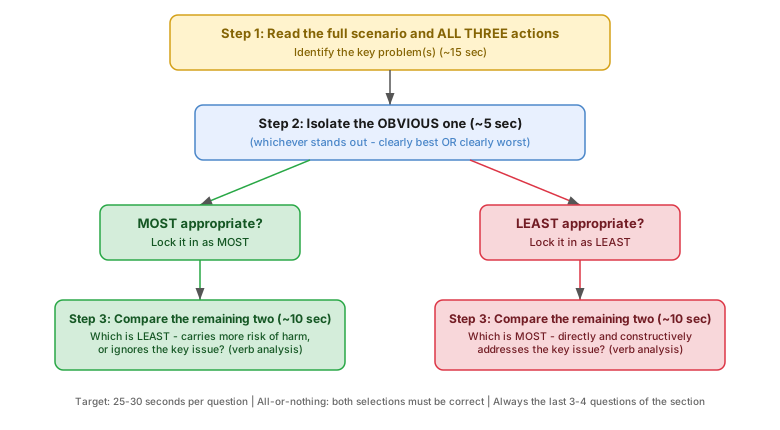
You don't need to rank all three options perfectly. You need to isolate the obvious one first - the option that clearly stands out as best or worst - and then compare the remaining two.
Step 1: Read the full scenario and identify the key problem(s) (~15 seconds). What's wrong in this scenario? What ethical principle is at stake?
Step 2: Isolate the obvious one (~5 seconds). Read all three options quickly. One option usually jumps out as clearly best or clearly worst. Lock that in first.
Step 3: Compare the remaining two (~10 seconds). Which addresses more of the key problems? Apply verb analysis: collaborative > directive > passive. Which carries more risk of harm?
Step 4: Assign both labels. Most appropriate = addresses key issue directly, constructively, collaboratively. Least appropriate = ignores key issue, causes harm, or makes things worse.
Target time: 25-30 seconds per question.
The Verb Hierarchy
When comparing actions with similar content, the verb often decides which is most vs least appropriate. This hierarchy applies consistently:
Most appropriate verbs (collaborative, empathetic): explore, discuss, encourage, suggest, offer, ask.
Middle verbs (directive but not harmful): explain, advise, inform, tell.
Least appropriate verbs (passive, aggressive, harmful): ignore, dismiss, refuse, threaten, blame, do nothing.
What Makes Something "Most Appropriate"
- 1.Directly addresses the key problem
- 2.Uses a collaborative/empathetic verb
- 3.Respects autonomy and dignity
- 4.Is constructive (moves toward a solution)
- 5.Is proportionate (not an overreaction)
What Makes Something "Least Appropriate"
- 1.Ignores the key problem entirely
- 2.Makes the situation worse
- 3.Compromises patient safety or dignity
- 4.Breaches ethics (dishonesty, breach of confidence, discrimination)
- 5.Is passive when action is clearly needed
Tie-Breaking: When Two Options Look Equal
Sometimes two options seem equally good or equally bad. This is where most students lose marks.
If two options seem equally good, the most appropriate one addresses the root cause, not just a symptom.
Scenario: A patient is anxious about an upcoming procedure.
- (a) Explore what specifically is worrying the patient
- (b) Reassure the patient that everything will be fine
Both are "good." But (a) addresses the root cause - the specific source of anxiety. (b) addresses the symptom - the visible distress - without understanding what's driving it. (a) is most appropriate.
If two options seem equally bad, the least appropriate one carries more risk of harm or is harder to reverse.
Scenario: Colleague confides they've been taking painkillers from the ward supply.
- (a) Say nothing because it's their personal choice
- (b) Confront them aggressively in front of the team
Both are bad. But (a) allows ongoing patient safety risk (medications being stolen, colleague potentially impaired). (b) is unprofessional but at least brings the issue into the open. (a) is least appropriate - the patient safety risk is unaddressed and ongoing.
Another useful tie-breaker: look at scope. The action that affects only the individual is usually less appropriate than the one that affects multiple people or ongoing patient care.
Worked Example: Isolation + Verb Analysis in Action
Scenario: Kira is a second-year medical student on a hospital placement. She overhears a healthcare assistant, Mo, telling a patient's teenage daughter about her father's test results in the corridor. The daughter becomes visibly upset. Mo hasn't checked whether the patient consented to sharing results with his family.
"Choose the most appropriate action AND the least appropriate action."
Options:
- (a) Approach Mo privately afterwards and explain that test results shouldn't be shared without the patient's consent
- (b) Immediately interrupt Mo and tell him to stop discussing the results
- (c) Say nothing because Mo is more experienced and should know the rules
Step 1: Key problem. Confidentiality breach - sharing patient test results without consent. The breach is happening now and causing distress. Principles: Confidentiality (C), Patient Safety (P).
Step 2: Isolate the obvious one. (c) is clearly worst - doing nothing about a confidentiality breach because someone is more senior violates the principle that hierarchy doesn't excuse breaches. Lock in: Least appropriate = (c).
Step 3: Compare (a) vs (b). Both address the breach. (a) is private and uses a collaborative verb ("explain"). (b) is immediate and uses a directive verb ("tell" and "stop"), and it's public, which could embarrass Mo and escalate the situation. However, (b) has the advantage of stopping the breach right now. Still, (a) addresses the same issue without creating a scene. The breach - sharing test results - has already happened; interrupting aggressively won't undo the disclosure.
Most appropriate = (a). It addresses the core issue directly, privately, and constructively. Least appropriate = (c). Doing nothing about a breach is always wrong.
Full Worked Example
Scenario: Tara is a second-year medical student. During a group project, she discovers that Marcus, another group member, has submitted the same piece of work to two different modules. Tara has a good relationship with Marcus and knows he's been struggling with a heavy workload.
"Choose the most appropriate action AND the least appropriate action."
Options:
- (a) Speak to Marcus privately about what she has noticed and encourage him to talk to his tutor
- (b) Submit the group project without saying anything, since it doesn't directly affect their group's work
- (c) Email the module leader to report Marcus for academic misconduct
Step 1: Key problem. Academic dishonesty - submitting the same work to two modules. Principles: Honesty (H), Professionalism (P). Secondary: Marcus is struggling - Empathy (E) is relevant to HOW she addresses it, not WHETHER she addresses it.
Step 2: Isolate the obvious one. (b) is clearly the worst. It ignores academic dishonesty. The fact that it "doesn't directly affect their group" is irrelevant - dishonesty is dishonesty. Ignoring it is always wrong. Least appropriate = (b).
Step 3: Compare (a) vs (c). Both address the misconduct. (a) uses collaborative verbs: "speak" and "encourage." (c) goes straight to formal reporting, skipping local resolution. There's no patient safety issue, so local resolution first applies. (a) also shows empathy - she knows Marcus is struggling.
Root cause test: (a) addresses the root cause (Marcus's behaviour + the pressures causing it). (c) addresses the symptom (the rule was broken) without understanding context.
Most = (a), Least = (b).
Why (c) is the middle option: Reporting isn't wrong - the misconduct is real. But jumping to the module leader without talking to Marcus first is premature for a non-safety issue. If Marcus refused to self-report after Tara spoke to him, then (c) would become the next right step.
Strategy: When You Can't Isolate an Obvious One
Sometimes no option jumps out. Run through four criteria mentally:
- 1.Does it address the key issue directly?
- 2.Does it use a collaborative verb?
- 3.Is the risk of harm low?
- 4.Is it constructive?
The option that ticks the most is most appropriate. The one that ticks fewest is least appropriate. You don't need to draw a grid - running through these four questions will resolve ambiguous cases in 10-15 seconds.
All-or-Nothing: Strategic Implications
Because there are no partial marks, these questions carry disproportionate risk. If you're behind on time:
Rating questions (partial marks): Worth spending time on. Even a "close" answer scores.
Most/Least questions (no partial marks): Either get it right or get nothing. If you're guessing, your odds are 1 in 3 (3 options for most, then the least is determined). Not great odds, but still worth a quick attempt.
Don't skip these questions - even a 10-second attempt using verb analysis gives you better-than-random odds. But if you're behind on pace, prioritise the rating questions where partial marks protect you.
Common Mistakes
| Mistake | How to Avoid |
|---|---|
| Trying to rank all three simultaneously | Isolate the obvious one FIRST, then compare the remaining two |
| Ignoring the verb | Two options with similar content but different verbs will have different ratings. Check the verb |
| Confusing "not ideal" with "least appropriate" | "Not ideal" is the middle option. "Least appropriate" is actively wrong or harmful |
| Not using tie-breakers | When two options look equal, ask: which addresses the root cause? Which carries more risk of harm? |
| Spending too long | These are all-or-nothing. 25-30 seconds maximum. If unsure after 30 seconds, go with your first instinct |
Summary
| Element | Detail |
|---|---|
| Signal | "Choose both the one most appropriate action and the one least appropriate action" |
| Technique | Isolation + Verb Analysis: spot the obvious one first, then compare the other two |
| Verb hierarchy | Explore/discuss/encourage > explain/tell > ignore/dismiss/blame |
| Tie-breaking | Root cause > symptom. Higher risk of harm = less appropriate. |
| Most appropriate | Directly addresses key issue, collaborative, constructive, proportionate |
| Least appropriate | Ignores key issue, causes harm, breaches ethics, passive when action is needed |
| Time target | 25-30 seconds |
| Partial marks | No. Both must be correct or you score zero. |
Put It Into Practice
Apply the strategies learned in this lesson to real UCAT questions.