
Situational Judgement·Lesson 5.6·14 min read
Themes & Technique Map
The Pattern Bank
SJT scenarios aren't infinite. They draw from a small set of recurring themes. Recognising the theme gives you the ethical principle, which gives you the answer. Here are the themes that cover the vast majority of questions, grouped by the CHEAP PET principles they test.
1. Patient Safety and Prioritisation of Patient Care
Always the #1 priority. If someone is in danger, act immediately.
Scenario signals: medication error discovered, colleague impaired (alcohol, drugs, illness, emotional distress), equipment malfunction, patient in pain or at risk.
- Escalate immediately to someone who can act - A
- Intervene directly if trained and able - A
- "Wait and see" / observe without acting - C or D
- Ignore because it's not your responsibility - D
Patient safety is the one theme that overrides local resolution. Don't try to handle it yourself if a senior can act faster.
2. Recognising and Working Within Limits of Competence
Act within your abilities. Students must seek supervision. Never "power through" something you can't do.
Scenario signals: asked to perform a procedure you haven't been trained for, pressured to act beyond your authority, tempted to "have a go" to impress a senior.
- Explain you're not trained and seek supervision - A
- Offer to assist while a qualified person leads - A or B
- Attempt the task alone without telling anyone - D
- Refuse but offer no alternative or explanation - C
3. Honesty, Integrity, and Admitting Mistakes
Always acknowledge. Always report. Never cover up.
Scenario signals: someone made an error (forgot a test, gave wrong info, missed a step), pressure to hide the mistake, a colleague asks you to stay quiet.
- Report the error immediately, even if no harm was done - A
- Apologise to the patient honestly - A
- Discuss what happened and how to prevent it - A
- Minimise, downplay, or hide the error - D
- Blame someone else - D
4. Academic Dishonesty, Plagiarism, and Fraud
Any factor encouraging cheating = D. Calling it out = A.
Scenario signals: friend copied an assignment, student asks you to sign their attendance, plagiarism or falsified data discovered.
- Address it directly with the person - A
- Report to appropriate authority - A or B
- Ignore because it doesn't affect you - C or D
- Help cover it up / stay silent - D
Factors that are "not important at all": "It happened a long time ago." "Other students do it too." "They are your friend." "Nobody was harmed."
5. Confidentiality and Data Protection
Don't share patient information, even with family, unless specific exceptions apply.
Scenario signals: family member asks for patient information, colleague discusses patient in public space, social media post contains patient details, fellow student asks to look at patient records.
- Protect the information - A
- Explain why you can't share - A
- Suggest the relative speak to the patient directly - A or B
- Share information "just this once" - D
- Post anonymised details (still identifiable) - D
Exceptions (when breaching IS appropriate): serious risk of harm to patient or others, legal requirement (court order), public interest (e.g., infectious disease), child safeguarding concerns.
6. Raising Concerns / Whistleblowing
Duty to raise concerns about unsafe or unprofessional behaviour, regardless of seniority.
Scenario signals: witnessing unprofessional conduct by a senior or peer, deciding whether and how to raise it.
- Raise the concern through appropriate channels - A
- Speak to the person directly first (if safe) - A or B
- Stay silent because they're senior - D
- Stay silent because "it's not my place" - D
7. Bullying, Discrimination, and Harassment
Zero tolerance. Medical professionals must not abuse, discriminate against, bully, or harass anyone.
Scenario signals: discriminatory remarks, offensive jokes, disrespectful treatment based on protected characteristics, student being singled out or belittled.
- Challenge the behaviour professionally - A
- Report through appropriate channels if it continues - A or B
- Laugh along or participate - D
- Ignore it because "it was just a joke" - C or D
8. Effective Teamwork and Group Dynamics
Issues should be resolved locally before escalating.
Scenario signals: group projects, unequal contribution, domineering members, managing disagreements within a team.
- Talk to the person directly and privately - A
- Report to tutor immediately (without speaking to person) - C or D
- Escalate only if no improvement after direct conversation - A or B
9. Supporting Colleague Wellbeing and Mental Health
If a colleague is struggling, support them. Concern is appropriate. Ignoring is not.
Scenario signals: friend showing signs of depression, withdrawal, or burnout; colleague missing work, arriving late, making errors; personal problems affecting professional performance.
- Talk to them privately, express concern - A
- Offer practical support or suggest resources - A or B
- Report directly to senior without speaking to them (unless patient safety at risk) - C
- Ignore because it's their personal business - D
10. Effective Patient Communication and Empathy
Explore concerns, provide clear information. Never be dismissive.
Scenario signals: patients who are upset, anxious, confused, non-compliant, or have language barriers.
- "Explore why they feel that way" - rated highest
- "Acknowledge their feelings" - high
- "Tell them what to do" - lower
- "Dismiss their feelings" - rated lowest
- "Please calm down" - D (always)
11. Scope of Practice and Seeking Senior Advice (Escalation)
Know when to escalate. Seeking senior input is a professional responsibility, not a weakness.
Scenario signals: encountering a situation beyond your authority or expertise, deciding whether to act independently or seek guidance.
- Acknowledge your limits and seek advice - A
- "Wanting to appear competent" - D as a factor
- Acting independently when you shouldn't - C or D
12. Professional Boundaries and Appropriate Conduct
Same standards apply in every context: clinical, university, social, online.
Scenario signals: inappropriate social media behaviour, phone use during clinical sessions, blurred personal/professional lines, accepting gifts from patients.
- Maintain boundaries, explain why if needed - A
- Address unprofessional behaviour directly - A or B
- Participate in unprofessional behaviour - D
- "It's just social media, it doesn't matter" - D
13. Balancing Personal Wellbeing with Professional Duties
Patient safety overrides, but proper communication can resolve conflicts.
Scenario signals: personal circumstances (family emergencies, emotional distress, scheduling conflicts) competing with professional obligations.
- Communicate about the conflict honestly - A
- Prioritise patient safety if they conflict - A
- Silently abandon obligations - C or D
14. Responding to and Giving Constructive Feedback
Openness to feedback is essential. Deliver feedback constructively and sensitively.
Scenario signals: receiving negative feedback, giving honest feedback to peers, using feedback for professional development.
- Accept feedback professionally and reflect - A
- Provide honest private feedback to peers - A or B
- Report the person giving you feedback - D (unless the feedback was abusive)
- Dismiss or ignore feedback - C or D
15. Informed Consent and Patient Autonomy
Patients have the right to make informed decisions including refusing treatment.
Scenario signals: patient refusing treatment, family trying to make decisions for the patient, patient not fully informed about a procedure.
- Respect the patient's informed decision - A
- Ensure the patient has all relevant information - A
- Override patient's wishes "for their own good" - D
- Share information with family without consent (unless patient lacks capacity) - D
16. Managing Conflict Between Colleagues
Address directly, privately, constructively. Local resolution first.
Scenario signals: interpersonal friction or disagreement between team members.
- Speak to the person privately about the issue - A
- Escalate immediately without attempting local resolution - C
- Ignore the conflict and hope it resolves - C or D
17. Handling Complaints and Angry/Distressed Patients or Relatives
Acknowledge complaints, don't dismiss. Never say "calm down." Follow formal procedures.
Scenario signals: patients or relatives who are angry, demanding, or making complaints.
- Acknowledge their concern empathetically - A
- Explain what you can and can't share - A or B
- Suggest they speak to the treating clinician - A or B
- Share patient details to calm them down - D
- Dismiss or ignore their distress - D
18. Adhering to Rules, Policies, and Institutional Regulations
Policies exist to protect patients and staff. Compliance is mandatory.
Scenario signals: institutional rules (attendance policies, phone policies, ID badges, recording, drug administration) being tested.
- Follow the policy - A
- University/hospital policy as a factor - A (very important)
- "Everyone else does it" as justification - D (not important at all)
19. Substance Misuse and Fitness to Practise
Impaired colleagues must not interact with patients. Report and support.
Scenario signals: drug or alcohol use, addiction, impairment affecting ability to practise safely.
- Report to appropriate person immediately - A (patient safety)
- Offer support alongside reporting - A or B
- "Have a quiet word" and leave it at that - C (insufficient for safety)
- Ignore it - D
20. Colleague Performance Issues and Underperformance
Patient care depends on every team member. Address supportively first, then escalate.
Scenario signals: colleague arriving late, not completing tasks, making repeated errors, declining performance.
- Talk to them privately first - A
- Express concern, offer support - A or B
- Escalate if patient safety affected or no improvement - A
- Ignore the decline - C or D
21. Appropriate Use of Hierarchy and Challenging Senior Authority
Patient safety overrides hierarchy. Speak up respectfully through appropriate channels.
Scenario signals: challenging a senior who makes a mistake, behaves inappropriately, or pressures a junior.
- Speak up respectfully about the mistake - A
- Escalate if the senior dismisses your concern - A or B
- Stay silent because they're senior - D
22. Dealing with Difficult or Vulnerable Patients
Whole-person care. Be aware of vulnerability factors. Adapt communication accordingly.
Scenario signals: patients who are vulnerable (children, elderly, non-English speakers), emotionally distressed, or in difficult life circumstances.
- Signpost to appropriate support services - A
- Acknowledge their distress empathetically - A
- "Things will get better" (empty reassurance) - D
- Continue a procedure when a child is distressed - D
23. Managing Time and Competing Priorities
Clinical urgency takes precedence. Communicate about conflicts rather than silently abandoning obligations.
Scenario signals: simultaneous demands - urgent patients vs duties, meetings vs clinical opportunities, personal vs professional.
- Prioritise clinical urgency - A
- Communicate about the conflict - A or B
- "Not my job" as a factor - D (not important at all)
- Silently abandon a task - C or D
Theme Conflict Resolution: The Priority Hierarchy
The themes above don't exist in isolation. Real questions often pit two or more against each other. When principles collide, this hierarchy tells you which one wins:
| Priority | Principle | Rule |
|---|---|---|
| 1 | Patient Safety | If someone could be harmed, this overrides everything |
| 2 | Professional Duty / Following Protocol | Reporting errors, following policies, maintaining standards |
| 3 | Patient Autonomy / Dignity | Respect decisions, ensure informed consent. Overridden only by safety |
| 4 | Team Relationships / Working with Colleagues | Important, but never at the expense of patient care or professional standards |
| 5 | Personal Feelings / Convenience | Reputation, grades, comfort, friendships. Almost never a valid consideration |
When two principles clash, the higher-ranked one wins.
- Patient safety vs team relationships: a colleague is impaired - report them even if it damages the friendship. (Level 1 beats Level 4)
- Professional duty vs patient autonomy: a patient refuses to let you document their allergy - you document it anyway, duty of care requires it. (Level 2 beats Level 3, but only just)
- Patient autonomy vs personal feelings: a patient refuses treatment you think they need - respect their decision. (Level 3 beats Level 5)
The Common Scenario Pattern Bank
These patterns come up repeatedly. Knowing the expected response saves you thinking time.
| Scenario Pattern | Expected Response |
|---|---|
| Colleague smells of alcohol at work | Patient safety - escalate immediately to a senior. Do NOT "have a quiet word" first. |
| Patient refuses treatment (competent adult) | Respect autonomy IF the patient has capacity. Explore their concerns. Never coerce. |
| Asked to do something beyond your competence | Acknowledge your limits honestly. Seek supervision. Offer to assist/observe. |
| Witness bullying or harassment | Address it. Speak to the person if safe. Escalate if it continues or the perpetrator is senior. |
| Patient tells you something in confidence about self-harm | Duty of care may override confidentiality. Explain you may need to share this. Encourage them to seek help. Involve a senior. |
| Colleague making errors (no immediate patient risk) | Talk to them privately first. Express concern, offer support. Escalate only if unresolved or patient safety becomes at risk. |
| Family member demands patient information | Empathise. Explain you can't share without patient consent. Suggest they speak to the patient directly. |
| Senior makes a mistake (e.g., wrong prescription) | Speak up. Patient safety overrides hierarchy. Be respectful but direct. |
| Group member not contributing | Talk to them privately. Local resolution first. Only escalate if no improvement. |
| Student asked to falsify attendance / records | Refuse. Professional misconduct. No excuse justifies it. |
A Note on Cultural Sensitivity
The UCAT expects answers based on UK GMC (General Medical Council) guidelines and NHS values, not personal cultural norms. This matters because:
- Some cultural backgrounds emphasise family decision-making over individual autonomy. The UCAT expects you to prioritise the patient's own wishes (if they have capacity).
- Some cultures treat hierarchy as inviolable. The UCAT expects you to challenge a senior if patient safety is at risk.
- Some cultural contexts treat mental health or self-harm as taboo. The UCAT expects you to address these directly and supportively.
This isn't about whether your cultural perspective is "wrong." It's about recognising that the exam tests one specific set of professional standards: those of a UK medical professional. Answer accordingly.
The Complete SJT Technique Map
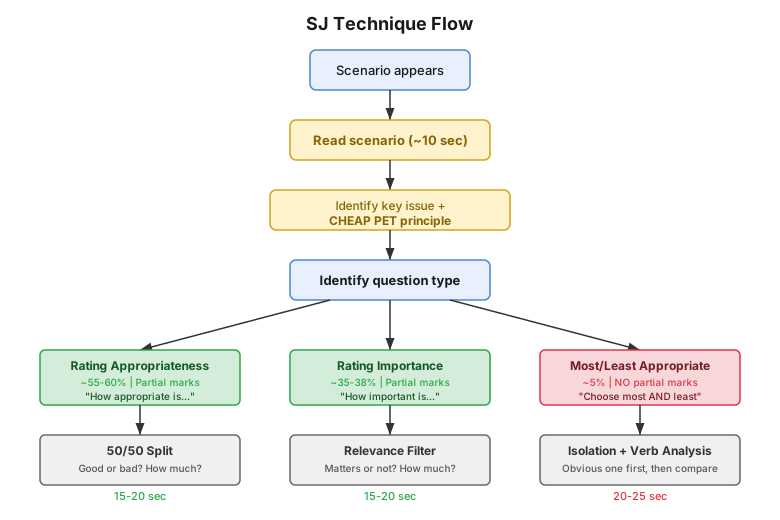
Time Management in SJT
SJT is the fastest section in the UCAT. At ~23 seconds per question across 69 questions in 26 minutes, you can't afford to deliberate. But the good news: SJT rarely requires deep analysis. Most answers come from recognising the theme and applying the principle.
The Timer Formula
Remaining questions x 0.38 = minutes you should have left.
- 69 questions left = 26 minutes (start of section)
- 50 questions left = 19 minutes
- 30 questions left = 11 minutes
- 15 questions left = 6 minutes
If you have less time than this, you're behind. Speed up on rating questions (they're fastest).
Triage: Where to Spend Your Time
SJT doesn't usually need triage - all questions are fast. But if you're running out of time:
Priority 1: Rating questions (both types). Partial marks protect you. Even a "close" answer scores something. Time: 15-20 seconds each.
Priority 2: Ranking (Most/Least) questions. No partial marks. All-or-nothing, but still worth attempting. A quick verb analysis gives better odds than random guessing. Time: 25-30 seconds each.
Emergency mode (under 3 minutes, many questions left): Rating questions - first split only (Good/Bad), pick A or D. Ranking - identify the verb hierarchy, pick extremes. Never leave a question blank.
Quick Reference Card
| I see... | I do... | Time |
|---|---|---|
| "How important is this factor?" | RELEVANCE FILTER: Matters or doesn't? Then how much? Remember: C = neutral | 15-20s |
| "How appropriate is this action?" | 50/50 SPLIT: Good or bad? Then how much? | 15-20s |
| "Choose the one most and one least appropriate" | ISOLATION + VERB ANALYSIS: Spot the obvious one, compare remaining two | 25-30s |
| Self-interest factor (grades, reputation, fear) | Select D immediately | 5s |
| Patient safety at risk | Escalate immediately = A | 5s |
| Two principles conflict | Use priority hierarchy: Safety > Duty > Autonomy > Team > Personal | 5s |
The Complete SJT Game Plan
Before the section: Reset mentally. You're a medical professional now. Recall CHEAP PET. Patient Safety is #1. Remember: explore before judging, local resolution first.
For each scenario (~60-90 seconds for a set of 2-6 questions):
- 1.Read the scenario once (~10 sec). Identify the key issue. Which CHEAP PET principle applies?
- 2.For each question (~15-25 sec): identify question type, apply the matching technique, commit to your answer. Don't second-guess.
- 3.Check pace against timer formula. Adjust speed for next scenario if behind.
Last 2 minutes: Click answers for all remaining questions. Use first-split only: Good or Bad? Pick A or D. Never leave a question blank.
Practice Principles
Start untimed. Focus on identifying the theme and CHEAP PET principle for each scenario. Check if your theme identification matches the answer. This builds your pattern recognition before you add time pressure.
Then add the clock. Enforce the 50/50 Split and Relevance Filter. Aim for 20 seconds per question. Don't let yourself deliberate - make the two-split decision and move on.
Run full sections. Do a complete 69-question SJT section under timed conditions (26 minutes). Afterwards, categorise every mistake:
- Theme recognition error (didn't spot the principle)
- Split error (got Good/Bad wrong)
- Degree error (got A/B or C/D wrong)
Focus your next practice session on whichever category cost you the most marks. If you're mostly getting split errors, you need more CHEAP PET practice. If you're getting degree errors (A vs B, C vs D), work on the B/C and A/B distinctions.
Review before retesting. Go back through your mistakes, understand why the correct answer is correct, then run another timed section. The improvement between your first and second timed run is usually the biggest.
You now have the complete SJT toolkit. Every question type has a named technique, a time target, and a decision process. SJT rewards consistency: steady, principle-driven answers across 69 questions will outperform flashes of brilliance mixed with careless errors.