
University Selection·Lesson 1.1·12 min read
How Universities Select
For 2026 entry, 25,770 people applied to study medicine in the UK, competing for around 8,500 places. Dentistry is no easier, with roughly 9,000 applicants for around 1,100 funded places. By the end of the cycle only about one in three applicants has a place, and a large share of those who miss out never reach an interview at all.
Success is not only about better grades, a higher UCAT or a stronger interview. Many rejected applicants had profiles that would have been competitive somewhere else; they simply applied to the wrong four schools, and with different choices would have been invited to more interviews and converted some of them. Being strategic means picking not just four schools you want to attend, but four that together give you the best chance of getting through the funnel. It is the one decision you control completely, that costs you nothing, and that most applicants still get wrong.
The Selection Process
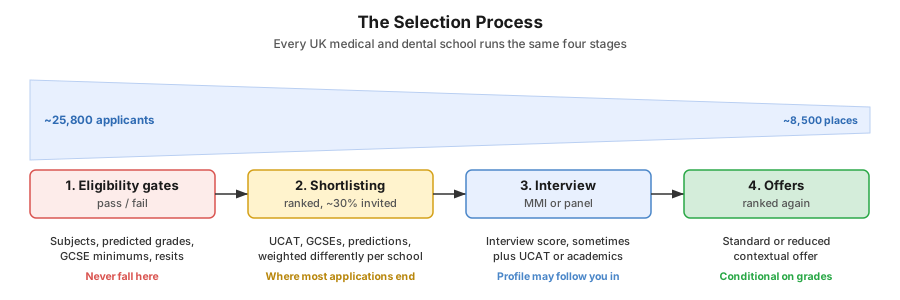
Every UK medical and dental school runs the same four stages. What differs, sometimes enormously, is what happens at each stage at a particular school.
Eligibility gates
The first thing every school does is check that you meet its hard requirements. Anyone who fails any one of them is rejected immediately, no matter how strong the rest of the application.
| Requirement | What it typically looks like |
|---|---|
| A-level subjects | Chemistry and/or Biology required; some schools specify a third |
| Minimum predicted grades | Usually AAA to A*AA |
| GCSE minimums | A number of grade 7s, or an overall profile threshold |
| Specific GCSE subjects | English, Maths and Science at a stated minimum grade |
| SJT band | A minimum SJT band you need to have achieved |
| UCAT | A fixed minimum UCAT score, set in advance - only a few schools use one |
| Resits and gap years | Some schools do not accept resits, or restrict repeat applicants |
| English language | IELTS or equivalent for international applicants |
This is the one stage you should never fall at, because it is the one stage where you have all the information. Every school states its entry requirements on its website, so for each of your four choices check that you clear every gate. A rejection here wastes an application you could have made somewhere you had a real chance.
Shortlisting
Once you clear the gates, the school has to cut a large pool down to the few hundred people it can interview, usually around 30% of applicants. This is where most applications end. Most schools convert your profile into a numeric score, rank everyone, and invite from the top until the interview slots are filled. The most common systems:
| System | How it works | Who it favours |
|---|---|---|
| Pure UCAT rank | Everyone is ranked by UCAT and the top scorers are interviewed until slots fill | High UCAT scorers, regardless of academics |
| UCAT threshold, then something else | The threshold is a floor. Clear it and your UCAT stops mattering; you're ranked on academics or written content instead | Anyone who clears the bar - beating it by 300 points gains nothing over beating it by 10 |
| Academic-first | GCSEs and predicted grades drive the ranking; UCAT is a modest threshold or tie-breaker | Strong academic profiles with an average UCAT |
| Composite scoring | Elements are converted to points and combined with a fixed weighting | Depends largely on the weightings used |
| Holistic | The application is judged as a whole, with no explicit formula; each applicant is considered individually | Applicants strong across the board; hardest to predict |
Cut-offs are outcomes, not rules. Each school interviews roughly the same number of applicants every year, so the line falls wherever the ranked list runs out: a stronger pool pushes it up, a weaker one pulls it down. In practice most thresholds stay fairly stable year to year, so historical figures are a useful guide, but not a guarantee.
Scores are relative to where you apply
Take a UCAT of 2,000, which puts you in roughly the top third of test takers. At Imperial, which ranks purely on UCAT and had a 2026 threshold of 2320, it is far below the line and would be rejected. At Liverpool, which also ranks purely on UCAT, the 2026 line was 1960, so the same score would get an interview. At Exeter, A-levels are worth up to 90 points and the UCAT can only deduct up to 32, so the score matters far less than the academic profile attached to it.
To see how much this matters, take two applicants, both predicted AAA, both applying to well-regarded mid-table schools:
- Jamie: UCAT 1,900 (around the 50th percentile), nine grade 9s at GCSE
- Sam: UCAT 2,100 (top 20%), nine grade 7s at GCSE
| School | How it shortlists | Jamie | Sam |
|---|---|---|---|
| Liverpool | Pure UCAT rank - 2026 threshold of 1960 | Very unlikely | Very likely |
| Anglia Ruskin | Pure UCAT rank - 2026 threshold of 2010 | Very unlikely | Likely |
| Cardiff | Score out of 28: GCSEs up to 24 points, UCAT up to 3 | Likely | Very unlikely |
| Leicester | Score out of 96: best 8 GCSEs up to 48 points, UCAT up to 48 | Likely | Unlikely |
Liverpool and Anglia Ruskin rank on UCAT alone, so Sam is interviewed at both and Jamie rejected at both. Cardiff and Leicester score mostly on GCSEs, so the result flips. If Jamie applies to Liverpool and Anglia Ruskin he gets no interviews; the same profile sent to Cardiff and Leicester gets two. For Sam it is exactly reversed. Same two applicants, same scores - the outcome is decided entirely by where they applied.
Applicant pools
Most schools do not rank all their applicants in one list - they sort applicants into groups and treat each differently. The pools are typically:
- Home: UK students paying home fees, nearly always the largest applicant pool.
- Contextual: home applicants with circumstances that may have limited their educational opportunities, such as a lower-performing school, free school meals, a low-participation postcode, care experience, or completion of an access programme. Living near a university can also count: Anglia Ruskin uplifts the UCAT of East of England and Essex applicants, and Keele awards an extra shortlisting point for attending a school in its region. Around 30% of UK medical places go to contextual applicants.
- International: applicants paying overseas fees. Schools usually have a small fixed number of international places, around one in ten, and almost always rank them separately.
Different thresholds
The threshold you need to clear depends on your group, and the gap can be large. Imperial ranks on UCAT alone and runs three separate pools: in 2026 the home threshold was 2320, the contextual (Widening Participation) threshold 2170 and the overseas threshold 2310 - so a home applicant on 2,200 is rejected while the same score with WP status is interviewed. At Liverpool the 2026 line was 1960 for home and 2080 for international applicants.
How schools treat different pools
Schools apply the difference through three mechanisms, often in combination. Knowing which applies to you tells you what your real threshold is.
| Mechanism | How it works | Examples |
|---|---|---|
| Separate ranking | Each group is ranked as its own list, and the top share of each is invited. International slots are usually a fixed cap; home groups are often allocated interviews in proportion to their share of applicants | Most schools, for international applicants |
| Uplift | Everyone is in one list, but contextual applicants have their score boosted before ranking. The formula and cut-off are the same for everyone; the uplifted score gets you invited with a lower raw score | Brunel adds 5% to UCAT; Glasgow 5-20% depending on markers held; Birmingham reserves 15% of its rubric for contextual points |
| Guaranteed interview | The ranking is skipped altogether for certain applicants who meet the academic requirements. Where you qualify, this is the single biggest advantage in the process | Birmingham's Pathways programme; Anglia Ruskin for eligible contextual applicants with SJT Band 1-3, regardless of UCAT score |
| All contextualised | No separate contextual pool - every applicant's record is read in the context of their school and background | Oxford adjusts everyone's GCSE performance against their school's results |
Your group also changes the offer you receive. Most schools make a reduced contextual offer, typically one or two grades below standard, such as ABB at Liverpool, Bristol or Newcastle against a standard AAA or A*AA. International applicants usually face extra requirements such as an English-language qualification.
Interview and offers
What the interview looks like
Once shortlisted you are invited to interview, which usually decides whether you get an offer. Most UK medical and dental schools use the MMI (multiple mini interview): a circuit of 6-10 stations of 5-8 minutes, each with a different interviewer and task, such as an ethical scenario, a role-play with an actor, a data interpretation or a question about your motivation. Each station is scored independently, so one bad station is contained rather than sinking the whole interview. A few schools, notably Oxford and Cambridge, use a panel interview: 20-30 minutes with two or three interviewers following one line of questioning and pushing on your answers. Panels reward depth and thinking aloud under challenge; MMIs reward consistency and resetting between tasks.
Whether your profile follows you in
What happens after the interview varies. Most schools rank on interview performance alone: your UCAT and grades got you into the room and then stop counting. A meaningful minority carry them forward and combine them with your interview score. Aston makes offers on 50% academics, 25% UCAT, 25% interview; Aberdeen on 30% academics, 20% UCAT, 50% interview; Newcastle on 50% academic screen, 50% interview.
| After interview | What it means for you |
|---|---|
| Interview alone | A clean slate. Getting shortlisted was the whole battle |
| Interview + UCAT | A weaker UCAT follows you to the end; you need a better interview than the people who started ahead of you, not an equal one |
| Interview + academics | Strong GCSEs and predictions keep paying off right up to the offer |
So if something in your profile is holding you back, the best schools for you are not just the ones that will shortlist you despite it. They are the ones that stop counting it once you are through the door.
Building Your Four
Medicine and dentistry are almost unique in one respect: you sit the UCAT over the summer, get your result on the day, and the UCAS deadline is in mid-October. Law, engineering and economics applicants all apply blind. You know the single most important variable in your application before you commit to a single choice. Yet most applicants decide where to apply in Year 12, before they have sat the test, and throw that advantage away. Everything below assumes you have your score in hand.
- 1.Audit your profile. Your UCAT total and where it sits nationally, your SJT band, your full GCSE profile, your predicted grades and subjects, whether you qualify as contextual anywhere, and any hard constraints on where you can live or what you can afford.
- 2.Ask the right question. Not "is my UCAT good enough?", which has no answer, but "which part of my profile is strongest relative to other applicants, and which schools weight that part most heavily?"
- 3.Diversify by system, not by prestige. Most students think they are spreading risk with one aspirational school, two realistic ones and one safe one. But if all four shortlist on the same thing, they have made the same bet four times, and if it fails, all four fail together. Real diversification means your four choices would fail for different reasons: one aspirational (below the likely line, but not absurdly so), one or two aligned (scoring that genuinely matches your strengths), and at least one high-probability (where you clearly clear the bar, ideally under a different system from the other three). Then check: if one thing goes wrong, do all four fail? If yes, potentially change one. The safest construction is simply the four schools where you have the strongest chance of reaching interview - the more interviews you get, the better your chance of ending the cycle with an offer.
- 4.Apply preferences last. Course style, intercalation, campus or city, distance from home, cost of living. These matter to your happiness for five or six years and are worth weighing, but they are tie-breakers between viable options, not the starting point. Find where you have a genuine chance first, then let preference choose between them.
There is one exception to diversifying. It manages uncertainty, and if one part of your profile is genuinely exceptional there is much less uncertainty to manage. A 2,400 UCAT is better spent on four UCAT-ranked schools than diluted across systems that don't reward it, and the same goes for a perfect GCSE profile and academically weighted schools. Concentrate when you are clearly at the top of a system; spread when you are somewhere in the middle.
Common Pitfalls
- Deciding where to apply before you have your UCAT result
- Never checking contextual eligibility, and disqualifying yourself from an advantage you actually qualify for
- Reading a home threshold when you are in a different pool
- Treating last year's cut-off as a rule rather than an estimate
- Applying somewhere you fail an eligibility gate, the one rejection that is entirely avoidable
Putting It Into Practice
Choosing well is what gets you into the room. Everything after that, your interview preparation, your reflection on work experience, your ethical reasoning, only matters if a shortlisting formula lets you through first.
Most of what decides that is not on the admissions pages. Schools describe their shortlisting in far vaguer terms than the process really is, and the detail that decides your application often sits behind that wording. Our University Selector holds the actual process for every UK medical and dental school, confirmed by the schools themselves, and checks your profile against each one.
University Selector
Put in your UCAT, GCSEs and predicted grades and see where you are most likely to be shortlisted, and which pool you are in when you are: Open the University Selector