
Personal Statement·Lesson 2.1·8 min read
The Personal Statement
What is the personal statement
In your UCAS application, you'll submit your qualifications, your predicted grades, a reference from your school, and a personal statement. The personal statement explains why you want to study your course, and what you've done to prepare for it. It is the only part of the application written by you, and is the only way the admissions team can hear directly from you before your interviews. Although applicants for all degrees have to write a personal statement, for medicine and dentistry it carries more weight; a bad personal statement can get you automatically rejected, or be the difference between getting an interview or not, and will often affect how your interview goes. So for medicine, it's essential that you write a statement that is specific, honest and clearly about medicine, and that you understand how each of your chosen schools will use it.
Why the personal statement matters for medicine
A medical degree takes five or six years, followed by two foundation years. The Department of Health puts the cost of training one doctor at around £230,000, of which £163,000 is non-repayable government grant. Places are also capped and heavily oversubscribed: for 2026 entry, 25,770 people applied to study medicine in the UK, competing for around 8,500 places, about three applicants for every seat. Dentistry is no easier, with roughly 9,000 applicants for around 1,100 funded places.
So the medical school is not just filling a course. It is committing public money and a sought-after place to train somebody for the next six years. It therefore wants to ensure that whoever it admits will see the degree through and go on to contribute to the NHS, because anyone who drops out early leaves a funded place unfilled that could have gone to another applicant.
Grades and the UCAT show whether you can learn, but they say nothing about whether you are passionate about being a doctor, whether you know what the job involves, or whether you have the potential to be a good one. This is what the personal statement is for: it gives the university insight into who you are. That is why it is not marked on academic ability, but on character, motivation and the insight you've drawn from your experiences.
How medical schools use your personal statement
Different medical and dental schools use the personal statement differently and at different stages of the process. Most do not score it, but almost every school does something with it, and knowing how your four choices use it tells you how much time it deserves and what it must avoid. Our University Selector has the exact policy for each school, though the most common uses are:
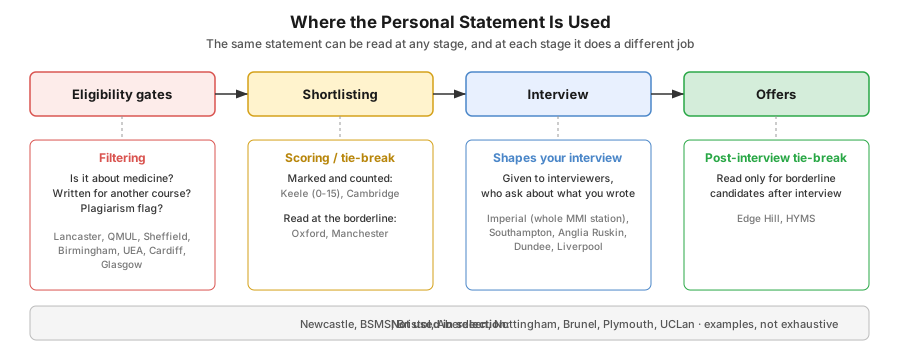
- Filtering. Before anything is scored, many schools check the statement is acceptable, and reject applicants whose statement is not clearly about medicine/dentistry, or is flagged by UCAS's plagiarism check. Lancaster, QMUL, Sheffield, Birmingham, UEA and Cardiff all screen this way, and Glasgow will outright reject a weak statement.
- Scoring. A few schools mark it and use it in their shortlisting scores. Keele scores it 0-15 against a published person specification, while Cambridge weighs it holistically alongside grades and UCAT.
- Tie-breaking. Where applicants have similar shortlisting scores, the admissions team can read the statement to decide between them. Oxford does this at its borderline review, while Edge Hill and HYMS do this after interview for borderline candidates. Manchester, which does not normally read the statement, will consult it in unusual cases.
- Interviews. Many schools give your statement to your interviewers, and it can influence what you're asked. Imperial builds an entire MMI station on it, Southampton uses it to shape the selection-day questions, and Anglia Ruskin, Dundee and Liverpool all say to expect to discuss it.
- Not used in selection. Some schools don't use it at all - Newcastle's interviewers never see it, and BSMS doesn't use it at any stage - while others, such as Bristol, Aberdeen, Nottingham, Brunel, Plymouth and UCLan, simply don't score it. These examples aren't exhaustive: check each of your choices in the University Selector.
Whatever the mix across your four choices, the same statement goes to all of them, so it has to pass every filter and satisfy every reader at once. And since it may be used in your interview months later, every claim in it has to be true and one that you can expand on.
Format of the personal statement
Since the 2026-entry cycle the statement is no longer one free-form essay. It is three structured answers, submitted through UCAS and read together as a single piece:
| Question | What UCAS wants | |
|---|---|---|
| Q1 | Why do you want to study this course or subject? | Your motivation, your curiosity beyond the syllabus, and if relevant your longer-term direction. Medicine specifically, not science or healthcare in general. |
| Q2 | How have your qualifications and studies helped you prepare? | What your studies taught you, not a list of subjects and grades, which are already on the form. |
| Q3 | What else have you done to prepare outside of education? | Work experience, volunteering, caring, jobs and sustained commitments, and what they taught you. UCAS itself notes medicine "leans more heavily" on this question. |
Your three answers are read as one statement, and therefore an example should ideally not be repeated across answers unless it adds a new insight. You have 4,000 characters shared across all three answers, with a minimum of 350 characters per answer. For medicine, Question 3 usually deserves the largest share.
What medical schools are looking for
Most personal statement advice stays vague because most schools don't publish their marking criteria. However, the Medical Schools Council does publish a Statement on the Core Values and Attributes Needed to Study Medicine, built directly on the GMC's Good Medical Practice. It groups the qualities into four domains:
| Domain | What it covers |
|---|---|
| Knowledge, skills and performance | Lifelong learning, honest self-reflection including on weaknesses, organisation, problem-solving, resilience under uncertainty and workload |
| Safety and quality | Clear, accurate communication; managing risk and competing demands; taking responsibility, including being open about mistakes |
| Communication, partnership and teamwork | Communicating with a wide range of people, working in a team, supporting and teaching others |
| Maintaining trust | Respect without discrimination, empathy, honesty and integrity |
Your statement should show evidence of these qualities, and that evidence can come from anywhere: including part-time jobs, caring for a relative, sport, music, school roles and any kind of volunteering. What matters is not where the experience came from but whether you understood what it showed and reflected on it honestly.
How this turns into marks: Keele's criteria
The one medical school that does publish its marking scheme is Keele. It is worth reading closely, because it shows exactly how a values-based framework like the MSC's turns into real marks on an application. These insights aren't specific to Keele: all medical schools look for similar things, and Keele's own website notes that personal statements addressing its criteria well "will also be viewed favourably by most other medical schools".
- 1.Understanding of the roles of a doctor within the healthcare team, community and society, gained through your own research and experience.
- 2.Awareness of the range of knowledge, skills and behaviours a medical student must acquire, and why these matter to you.
- 3.Evidence of a specific skill, gained through your studies, that will matter for becoming a doctor.
- 4.Ability to engage and communicate with people from a variety of backgrounds, and to help or support them.
- 5.Ability to balance responsibilities and time commitments over a prolonged period.
These five criteria are not weighted equally. Over half of the available marks are for the last two, engaging and supporting people and balancing sustained responsibility. Both are most naturally addressed in Question 3 of the personal statement, which is exactly why medicine applicants are consistently advised to give that question the most attention.
Deadline and timeline
Medicine has an earlier UCAS deadline than most courses: 15 October, 18:00 UK time, the year before entry. Most schools also set their own internal deadline in September, so aim to have your statement finished by early September, leaving only minor refinements for after.
| When | Do |
|---|---|
| Spring / early summer | Self-audit (lesson 2) and arrange any missing work experience or volunteering while there is still time |
| Summer holiday | First full draft of all three answers, before school and exam preparation compete for the same hours |
| Early to mid September | Proofread, check counts in the live UCAS counter, get honest feedback, and finish ahead of your school's deadline |
| Before 15 October | Submit |
In the next lesson we'll cover the work to do before you write a word: auditing your experiences, mapping them to what schools look for, and reflecting on them properly.